The future belongs to data and AI. A golden era is opening up for the people who build it
Clever models created enormous demand for well built data, and well built data is still a human craft. Here is what changes, what to learn, and what we are trying to do about it.
There is a quiet moment that happens in almost every data career.
You are looking at a table you built. It is small, maybe a few thousand rows. It loads in seconds. Nobody outside your laptop has ever used it. And still, something clicks. You realise that this thing you just built is the same shape as the thing that runs a bank, a hospital, a shipping company, a recommendation engine. Different scale, same idea.
That moment is worth paying attention to, because the next decade of technology runs on exactly that idea. The future belongs to data and AI. Not as a slogan, but as a plain description of where the work is going. And for people willing to learn the systems properly, a golden era is opening up.
This article is about why that is true, what actually changes, and what we at BricksNotes are trying to do about it.
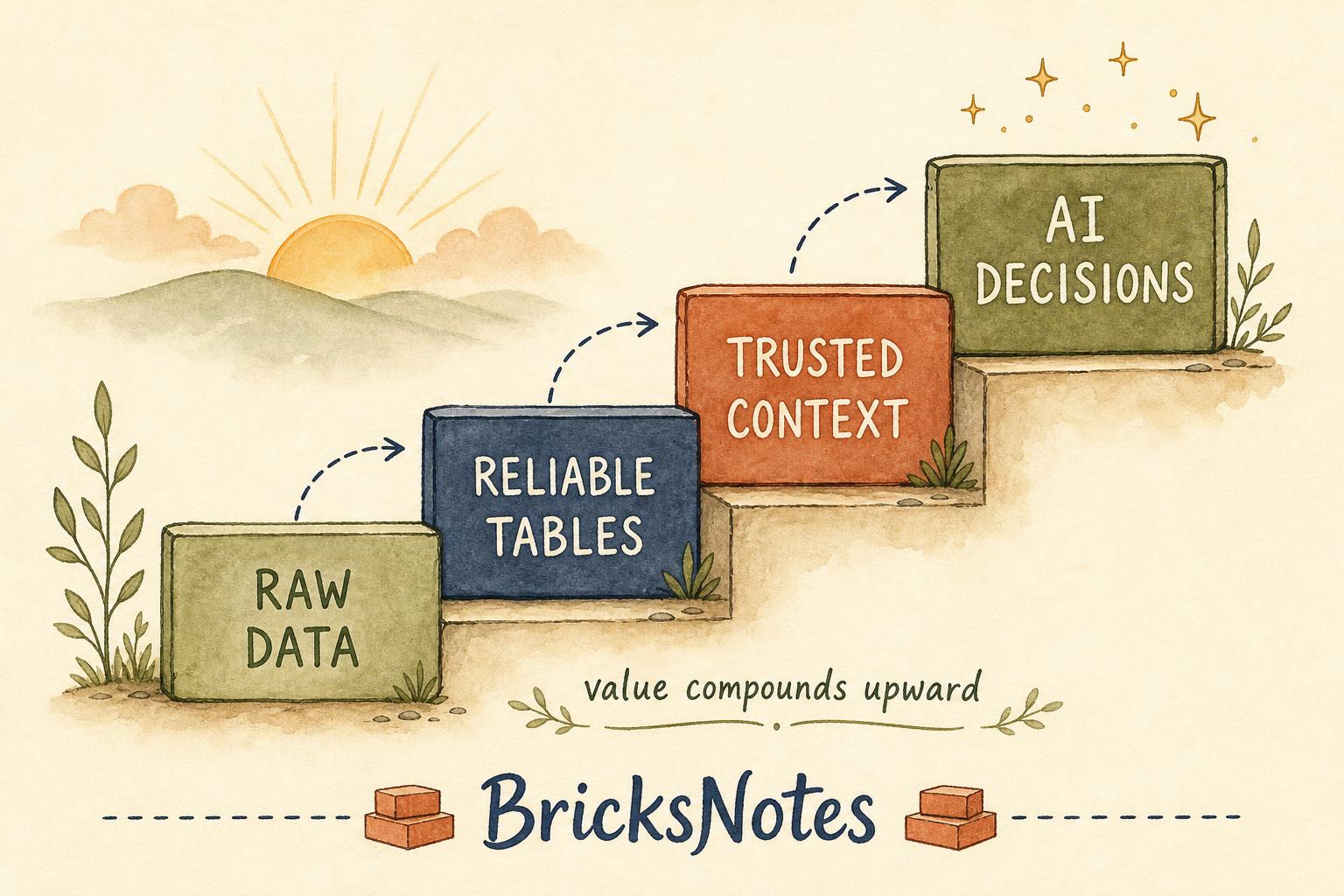
Value compounds upward. Every layer only works because the one below it is trustworthy.
Why this era is different
Every technology wave has a bottleneck. In the early web the bottleneck was distribution. In the mobile wave it was interface design. In this wave the bottleneck is data that can be trusted.
We have models now that can reason, summarise, plan, and write code. They are improving faster than most of us can keep up with. But a model is only as useful as the information it is standing on. Give a brilliant model a stale table, a duplicated order, or a column that quietly changed type last Tuesday, and it will produce a confident, well written, wrong answer.
This is the part people underestimate. The hard problem in AI is drifting away from the model and towards the data around it. Which means the people who understand how data actually behaves in a real system are becoming more valuable, not less.
We wrote about one version of this in why the next database may be built as much for agents as for developers, and about the practical side in what changes when an agent discovers and applies.
The golden era is for builders, not spectators
A golden era does not mean things get easy. It means the returns on doing the work are unusually high.
Right now a person with two or three years of honest practice in data engineering can walk into a room and be the most useful person there. Not because they know every service name, but because they can answer questions like:
Where did this number come from. Can we reproduce it. What happens if we rerun this job twice. Who is allowed to see this column. How stale is this table right now.
Those five questions are the entire foundation of trustworthy AI. They are also, not by accident, the questions that most teams cannot answer well today.
That gap is your opportunity. It is why we keep saying that understanding beats memorising. Tools change every quarter. The questions do not.
What actually gets built in this era
Let me be concrete, because vision without concrete examples is just noise.
Pipelines become decision paths. For years we measured how fast a pipeline ran. The honest number is how fast a decision gets made. We unpacked that in faster decisions, not faster pipelines, and it changes how you design. You start from the moment someone acts, then work backwards.
Reliability becomes the product. A pipeline that is right ninety percent of the time is not ninety percent useful. It is unusable, because nobody knows which ten percent to distrust. This is why we spend so much time on data quality checks, schema changes and data contracts, and safe reruns. Boring topics. Career defining skills.
Context becomes an engineering discipline. When a human reads a dashboard, they bring years of unwritten context with them. They know that the spike in March was a migration, not growth. An agent knows nothing unless you encode it. Naming, definitions, lineage, ownership, freshness expectations, all of that stops being documentation and becomes part of the system. Unity Catalog exists for this reason, and we cover it in the Unity Catalog lesson.
Data moves closer to where decisions happen. Databricks buying Electric was a signal, not a footnote. We looked at it in why data next to the agent matters and at the operational database side in Lakebase, explained simply.
None of this requires you to be at a large company. All of it can be practised in Databricks Free Edition, on a laptop, with a CSV file and an evening.
The skill path, honestly
People ask what to learn first. The answer has not changed much, and that stability is a gift.
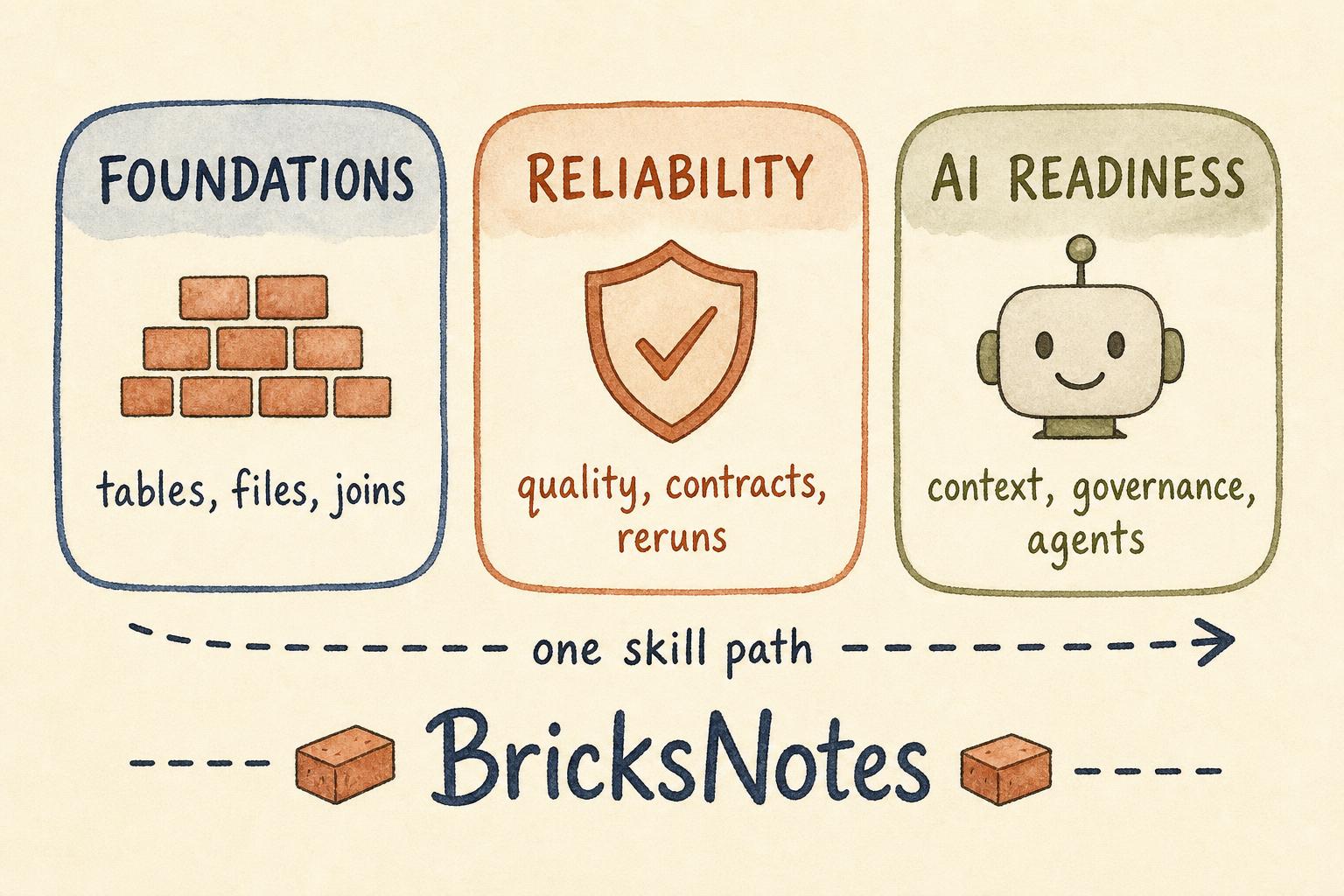
Start with foundations. Files, tables, and what a DataFrame really is. How a join works and why it sometimes takes seven hours. Our Delta Lake lesson and broadcast and shuffle joins article are the two places most people have their first real breakthrough.
Then reliability. Constraints, expectations, idempotent writes, backfills that do not break downstream tables, late arriving data, duplicates, and observability and alerts. This is the layer that turns a person who can write Spark into a person a team depends on.
Then AI readiness. Governance, lineage, semantics, freshness, and the habit of asking what an agent would need in order to be right. If you want the deeper argument for this layer, that is the whole subject of The Context Advantage.
You do not need to finish one layer before touching the next. But skipping the first two and jumping to agents is how people end up building things that demo beautifully and fail in production.
Where BricksNotes fits
Here is our part of it, said plainly.
We believe data and AI skills should not be locked behind expensive workspaces, vendor certifications, or six hour videos that never let you touch anything. So everything we build follows three rules.
It has to run. Every example is written for Databricks Free Edition wherever possible. When something genuinely needs a paid workspace, we say so and explain the concept instead of pretending. You can start with the very first lesson for free, and build your first end to end project with real datasets in a couple of evenings.
It has to explain why. Anyone can list commands. We try to explain what the system is doing underneath, because that is the knowledge that survives the next product rename. This is the whole reason Thinking in Data Engineering with Databricks exists as a book rather than a video course.
It has to be calm. No urgency, no hype, no promises of a six figure job in thirty days. Just clear writing, in simple English, for people who want to actually understand their craft. That is the tone across our lessons, our journal, and our videos.
We crossed a hundred thousand learners this year. We wrote about how that happened, and the honest answer was slow, steady, useful work. That is also our bet for the next hundred thousand.
What to do this week
Vision only matters if it turns into a small action. Pick one.
Open Databricks Free Edition and load a CSV into a Delta table. Just one. Then run DESCRIBE HISTORY on it and look at what Delta recorded about your own write.
Take a table you already have and try to answer the five questions from earlier. Where did this come from, can I reproduce it, what happens on a rerun, who can see it, how stale is it. Write the answers down. Notice which ones you cannot answer.
Build the first project end to end. Bronze, silver, gold, one merge, one quality check. It is the single fastest way to make the abstract concrete.
Then keep going. That is really the whole secret.
The part worth remembering
The golden era is not arriving because AI got clever. It is arriving because clever AI created enormous demand for well built data, and well built data is a human craft that takes practice.
That practice is available to you tonight, for free, on your own machine. There has genuinely never been a better time to learn this work.
Start where you are. One table, one pipeline, one honest question at a time.