Databricks acquired Electric. Why data next to the agent matters
An agent can reason in milliseconds and still wait on slow, distant, or stale data. That wait becomes part of the intelligence.
An agent can reason in milliseconds. It can still spend most of its life waiting.
That is the strange thing about the current moment. Models keep getting better every month. Yet the slowest part of many agent systems is not the thinking. It is the fetching. The agent asks for state, waits. Calls a tool, waits. Reads a record, waits. Then it does that again, and again, because a real task is rarely one step.
When an agent has to observe, decide, act, and repeat many times inside a single task, the delay stops being a performance detail. It becomes part of the intelligence. A model that reasons well on stale data is confidently wrong. A model that reasons well on distant data is slow. Both feel like a bad agent to the person using it, even when the model is excellent.
This is why the next phase of AI may depend as much on data architecture as on the model itself. And it is the lens to read one recent piece of news through: Databricks acquiring Electric.
The architecture we all learned was built for humans
Think about the shape of a normal enterprise application.
An app sends a request. A server queries a central database. The result travels back. A person looks at it and decides what to do next.
That shape works beautifully for that job. It has run banking, retail, and logistics for decades. It assumes something specific though: a human is in the loop, and humans are slow. A few hundred milliseconds of round trip disappears completely inside the time it takes someone to read a screen.
Agents break that assumption.
A single agent step might check its own state, query business data, call a tool, observe the result, update its memory, and decide again. Then repeat. Every round trip adds latency. Every stale copy adds risk. Every disconnected system makes the agent harder to build, harder to govern, and harder to trust.
We wrote about this shift in The data stack is being redesigned for AI agents and The next database may be built as much for agents as for developers. The Electric acquisition is that argument showing up as a purchase order.
What Electric actually built
Electric built technology for synchronizing Postgres data closer to the applications that use it.
Its best known project is PGlite, a lightweight Postgres that can run inside a browser tab, on a device, or inside an agent sandbox. Not a cache. Not a key value store pretending to be a database. Postgres, small enough to sit next to the code that queries it.
The idea is simple to state and hard to build. Instead of forcing every interaction to travel back to a remote database, some data and some query execution happen close to where the work is actually happening. Then that local state synchronizes back with the central Postgres.
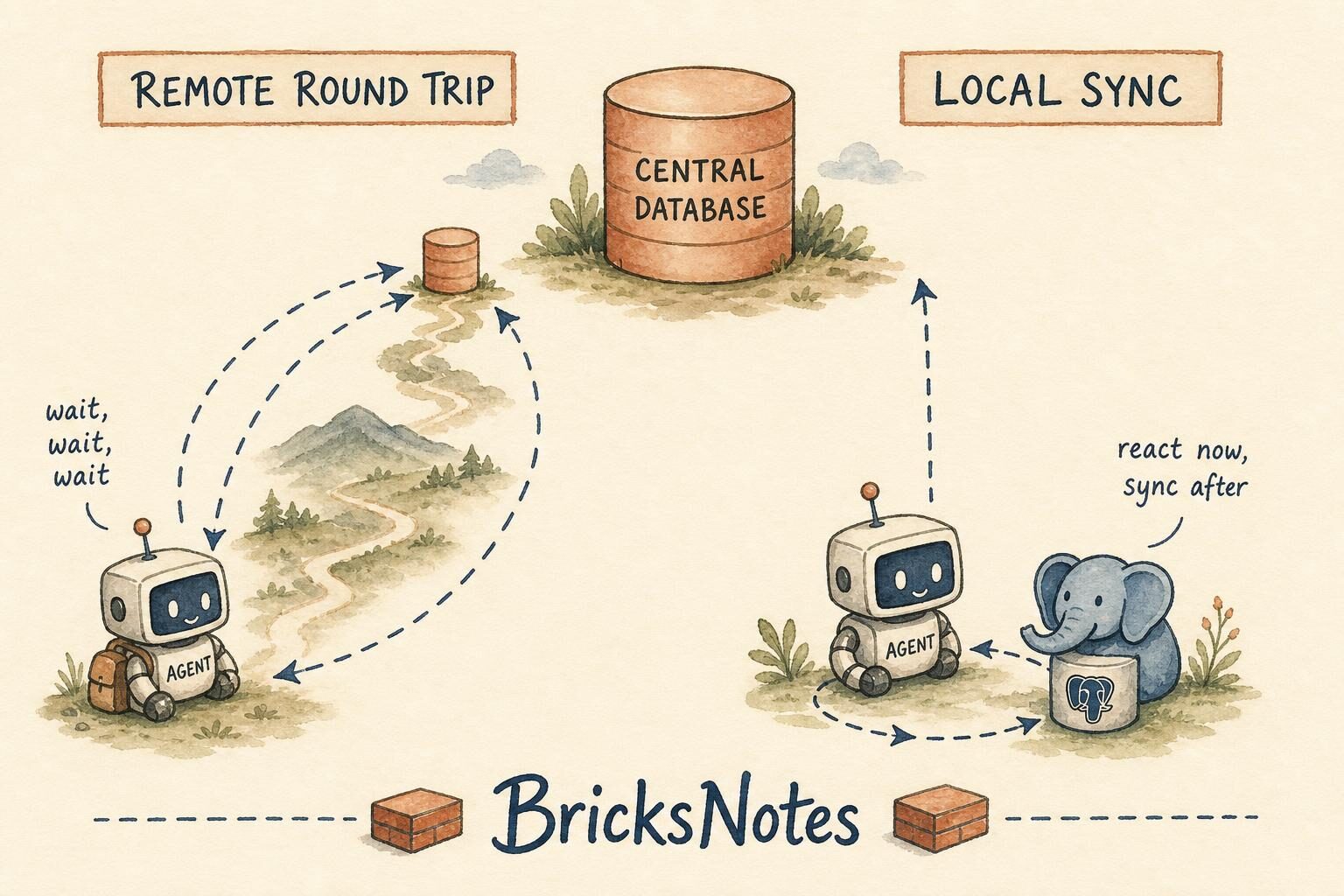
Picture a field service agent working a complicated job. It needs the customer record, the equipment history, the parts inventory, the open ticket, and its own notes from three steps ago.
If every reasoning step needs another remote request, the whole experience gets slow and fragile. One network hiccup and the agent loses its place. But if the relevant operational data is sitting right next to the agent, it reacts immediately and still syncs with the central system when it is done.
Same model. Different foundation. Very different product.
Where Lakebase fits
Lakebase is Databricks' managed, serverless Postgres for operational applications and AI agents. If you have not met it yet, we explained it from the beginning in Lakebase, explained simply.
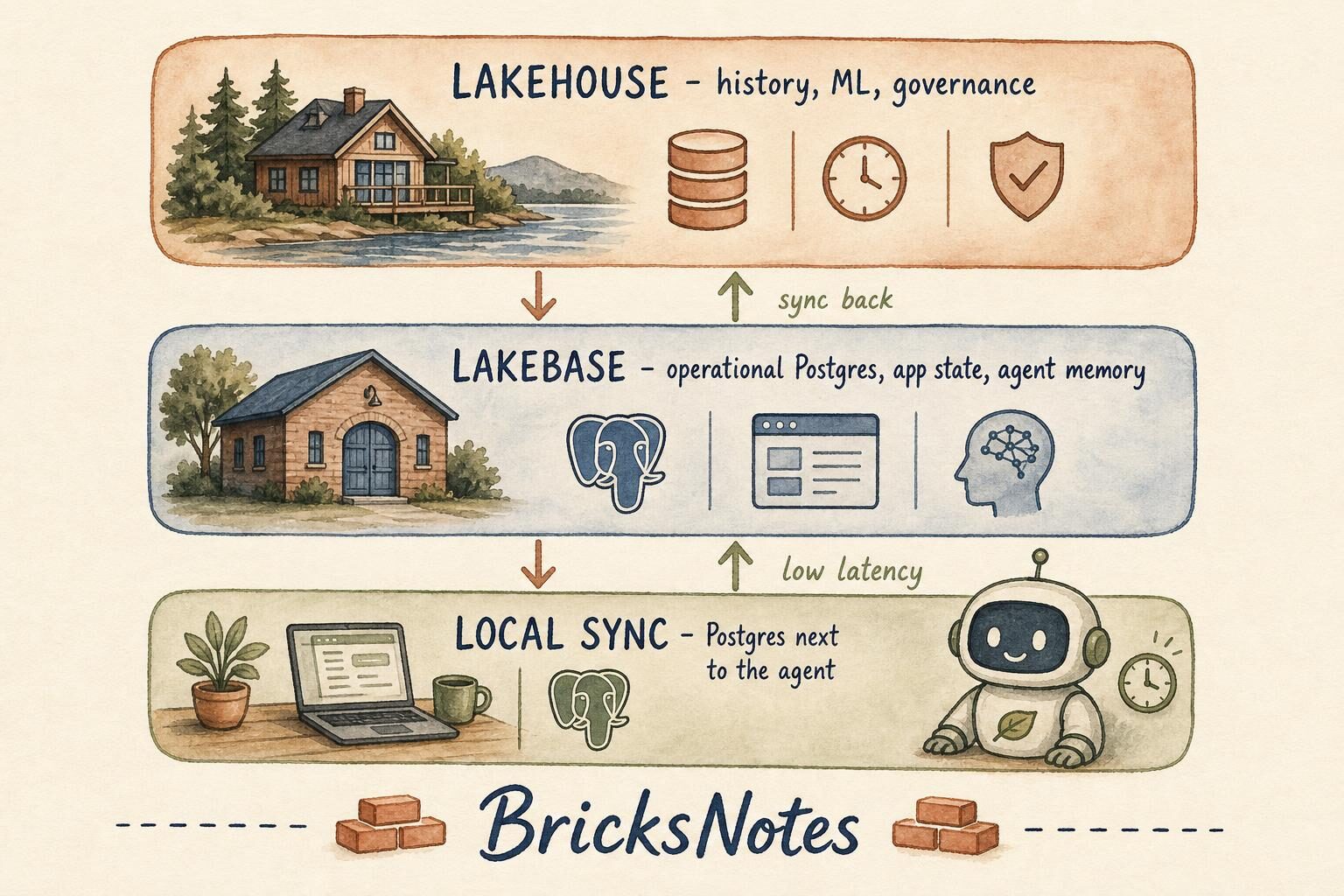
The division of labour is the part worth memorising.
The lakehouse holds history and intelligence. Years of events, governed enterprise tables, features, models, lineage. It is where you answer "what usually happens" and "what does this number mean."
Lakebase holds the operational side. Fast transactions, application state, agent memory, low latency reads of the row you need right now. It is where you answer "what is true about this customer at this second."
Databricks already connects the two. Governed Unity Catalog tables can be synced into Lakebase so an application serves lakehouse data through plain Postgres with low latency. Changes made in Postgres can flow back into Delta tables for analytics and audit. If you have built a serving layer by hand before, you know how much plumbing that removes.
Electric pushes that architecture one step further. Not just lakehouse to Postgres, but Postgres to the place the agent runs.
[!notice] Read it as three layers, not three products. The lakehouse gives history and intelligence. Lakebase gives operational state. Local sync gives the agent something to react to without waiting.
Why this is a data engineering story, not just a product story
It is tempting to file this under vendor news. It is not.
In the dashboard era, our job was to make information arrive in time for a person to look at it. Nightly was fine. Hourly was good. Fifteen minutes was impressive. The consumer was a human with a coffee and a browser tab.
In the agentic era, the consumer is a machine that observes and acts continuously. That changes four things about the work.
Freshness becomes part of intelligence. An agent acting on yesterday's inventory is not slightly wrong. It promises something you cannot deliver. This is the same discipline we cover in Incremental processing in the book, except the cost of lateness is now a bad action instead of a stale chart.
Latency becomes part of the experience. Nobody used to notice a 400 millisecond query inside a nightly job. Multiply it by forty agent steps and you have a product people abandon.
State becomes part of reasoning. Agent memory is a table. It has a schema, a growth rate, a retention policy, and a correctness problem. Somebody has to own it, and that somebody is a data engineer.
Synchronization becomes part of architecture. The moment the same data lives in the lakehouse, in Lakebase, and next to the agent, you are running a distributed system with copies. Copies drift. Which is exactly why the boring parts matter more, not less.
The boring parts that decide whether this works
Nothing about local sync removes the fundamentals. It raises the price of skipping them.
Governance. If data can travel closer to the agent, you need to know which data is allowed to travel, who can read it, and where it went. This is Unity Catalog work, and it stops being optional the moment copies exist outside the warehouse.
Data quality. An agent does not squint at a suspicious number and ask a colleague. It acts. Constraints and expectations are the only thing standing between a bad row and a bad decision, which is the argument we made in The pipeline was green. The numbers were wrong. and teach in Data quality.
Schema discipline. A synced table is a contract with something that cannot ask questions. When a source renames a column, a human notices the odd label. An agent keeps going. We wrote about that failure mode in The pipeline kept running.
Idempotency. Agents retry. Networks fail mid action. If the same step can run twice and leave two rows, you will find out in production. The job ran twice covers the habit.
Read that list again and notice something. It is the same list a good data engineer already works from. The skills transfer. The stakes rise.
What this means if you are learning right now
You do not need to build an agent platform this month to benefit from this.
What you need is the ability to reason about where data lives, how fresh it is, who is allowed to see it, and what happens when the same fact exists in three places. That is the thinking the whole Thinking in Data Engineering with Databricks book is built around, and it is what makes the difference between someone who can wire a pipeline and someone who can be trusted with a platform.
If you are starting from zero, the free lessons in Start here are the right first step. If you want to feel the operational side rather than read about it, build something small end to end with your first data engineering project.
The part worth remembering
A powerful agent without live data is limited. With slow access it is frustrating. Without governance it is risky. Without trusted business context it is confidently wrong.
So the AI race is not only a race to build smarter models. It is a race to build better foundations around them.
The model decides whether the reasoning is good. The architecture decides how quickly, how safely, and how accurately that reasoning turns into action. Databricks buying Electric is a bet on the second half of that sentence, and the second half is the part data engineers own.