Apache Spark 4.2: Defining truth in the age of AI
Metric Views, mature Spark Connect, vector search in SQL, and Auto CDC
Apache Spark 4.2 shipped in July 2026. The headline features are not incremental. They shift where the "truth" of your data lives, how teams and AI agents talk to Spark, and how streaming pipelines catch up with reality.
If you spend your days writing PySpark, running dashboards, or wiring up AI agents on top of Databricks, this release matters.
The real problem Spark 4.2 is solving
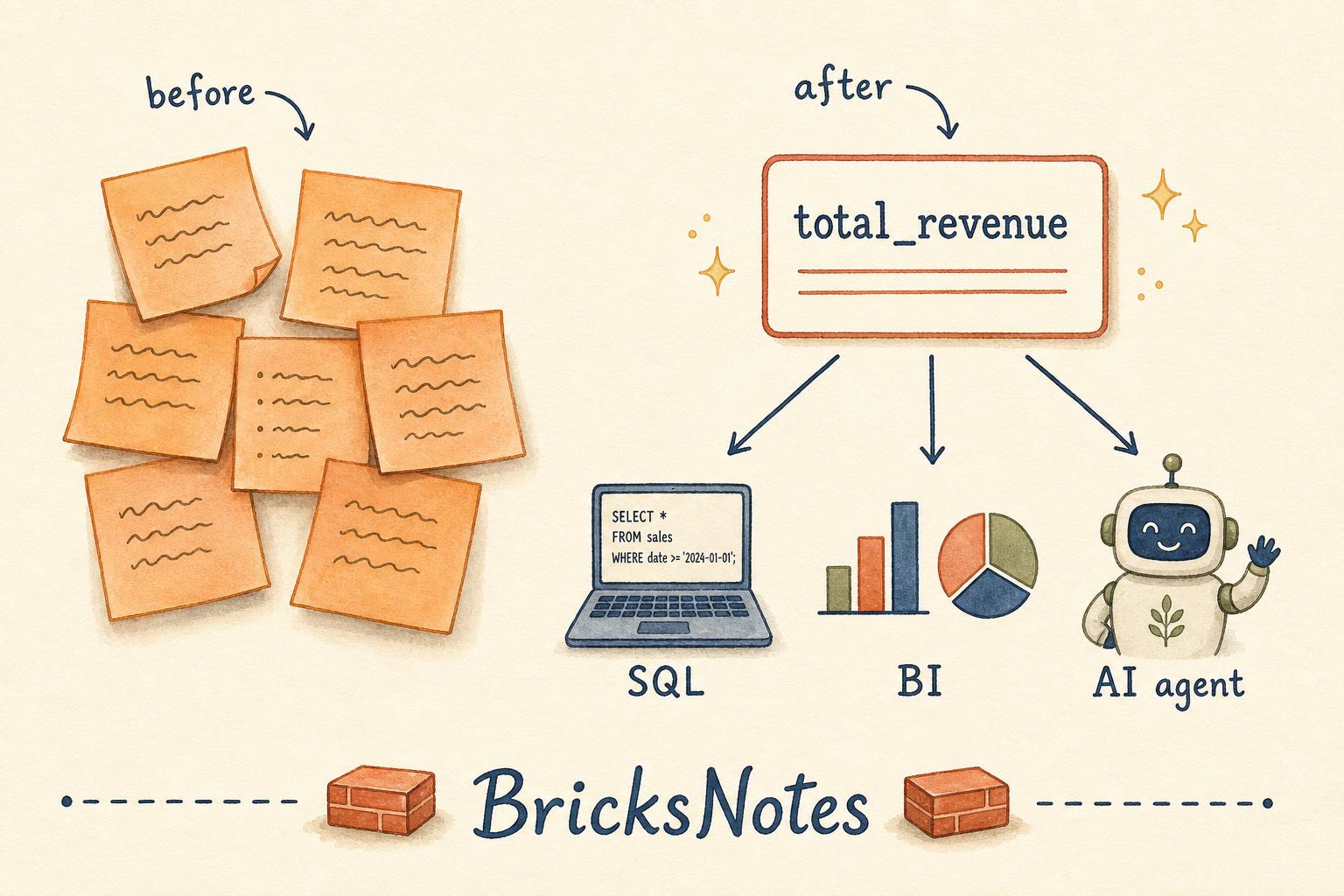
Every data team hits the same wall. The dashboard says revenue is one number. The finance report says another. The AI agent, asked the same question, invents a third.
The code is not wrong. The definitions are.
Ten notebooks each write sum(amount) slightly differently. One filters cancelled orders. One does not. One joins on a stale customer table. One uses gross, another uses net.
Spark 4.2 tries to fix this at the engine level, not with more documentation.
Metric Views: one definition, everywhere
Metric Views are the feature I would put on the front page.
You define a business metric once, in one place, and every consumer reads it from there. SQL queries. Dashboards. AI/BI Genie. Agent Bricks. All of them see the same number.
A simple example:
CREATE METRIC VIEW total_revenue AS
SELECT
  order_date,
  region,
  SUM(amount) AS revenue
FROM sales.orders
WHERE status = 'completed'
GROUP BY order_date, region
Any downstream query can now just ask for total_revenue by region, and Spark handles the rest. If the definition changes, it changes for everyone.
This is not a new idea. dbt metrics and LookML tried it. What is new is that this lives inside Spark, so PySpark jobs, SQL warehouse queries, and AI agents all resolve the same view. There is no separate semantic layer to babysit.
Why this matters for you:
- Fewer arguments in meetings about whose number is right
- AI agents built on your lakehouse stop hallucinating totals
- Onboarding a new analyst takes hours, not weeks
Spark Connect grew up
Spark Connect has been around, but 4.2 is where it feels finished.
The idea is simple. Instead of every client running a full Spark driver, the client sends a query plan over the network. A remote Spark server executes it and streams results back through Apache Arrow.
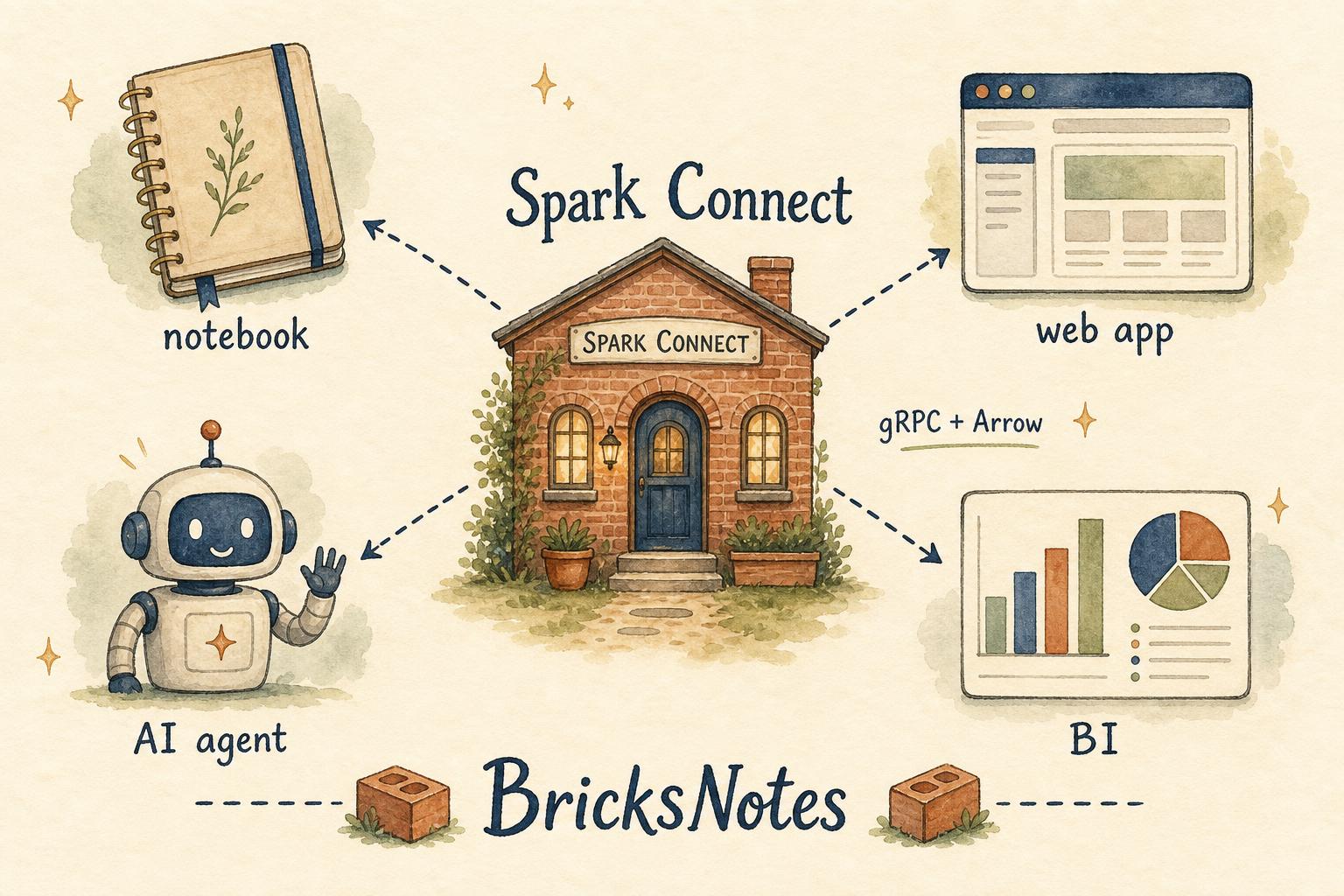
That sounds like plumbing. In practice it changes three things:
- Thin clients everywhere. A notebook, a web app, or an AI agent can talk to Spark without carrying the full JVM around.
- Language coverage. Python, SQL, Scala, and now Go and Rust clients can hit the same cluster.
- Isolation. One badly written job cannot crash the driver for everyone.
If you are building an AI agent that runs Spark queries on demand, Spark Connect is the piece that makes it safe to expose. See Your AI is ready, is your data foundation for the surrounding pattern.
Vector search inside Spark SQL
Vector similarity used to be a separate stack. A different database, a different query language, a different set of people maintaining it.
Spark 4.2 adds vector functions directly in SQL. You can now write:
SELECT product_id, description
FROM products
ORDER BY VECTOR_DISTANCE(embedding, :query_embedding)
LIMIT 10
Same table, same governance, same Unity Catalog policies. Retrieval-Augmented Generation and product search stop being two different infrastructures.
For anyone who has stitched together a lakehouse and a vector database with nightly sync jobs, this quietly removes one of the ugliest parts of the pipeline.
Auto CDC in Spark Declarative Pipelines
Change Data Capture used to mean writing MERGE statements by hand, worrying about late data, and building your own SCD Type 2 logic.
Auto CDC in Spark Declarative Pipelines (formerly DLT) does the boring parts for you. You point it at a source of changes and declare how you want the target to look. It figures out the merges, the ordering, and the history.
This does not replace understanding. If you are building slowly changing dimensions, you still need to know what Type 1 versus Type 2 means, when to use which, and what happens when a late update arrives out of order.
The book covers this end to end in the SCD Patterns chapter and the Incremental Processing chapter. Auto CDC is a shortcut, not a substitute for the mental model.
What to actually do this week
You do not need to adopt every feature at once. A calm order of operations:
- Pick one contested metric (revenue, active users, churn) and rewrite it as a Metric View. Point one dashboard and one Genie space at it. See how many follow-up questions disappear.
- Move one downstream tool to Spark Connect if you have a web app or agent that currently packages a full Spark client. The friction drop is worth it.
- Try VECTOR_DISTANCE on one table where you currently do keyword search. Compare results with a real user query. Do not migrate everything yet.
- Read one of your MERGE-heavy pipelines and see if Auto CDC would remove code. Do not rewrite it. Just notice.
How this changes what a data engineer does
Spark 4.2 is not asking you to learn a new API. It is asking you to spend less time being a translator between systems, and more time being the person who decides what the truth is.
Metric Views are governance. Spark Connect is architecture. Vector functions are simplification. Auto CDC is time back.
The engineers who benefit most from this release are the ones who stop hoarding transformation logic in notebooks and start publishing definitions the rest of the company can trust.
If that mindset shift is new, the Medallion Architecture chapter and the Unity Catalog chapter are where BricksNotes walks through it with runnable Free Edition examples.
Continue reading
- Design beautiful AI/BI dashboards people actually read
- Lakebase is GA, do you still need a separate Postgres
- Agent Bricks is GA, how to ship an agent without regret
For the full hands-on path from a fresh Databricks Free Edition workspace to production-shaped pipelines with Metric Views, Unity Catalog, and Declarative Pipelines, the BricksNotes book is the shortest way there.