I Failed the Databricks Associate Exam Twice. Here's What Fixed It.
A quiet, honest study plan for the third attempt.
I failed the Databricks Data Engineer Associate exam twice.
First attempt: 62%. Second attempt: 66%. Both times I walked out of the browser tab feeling the same thing. Not stupid. Just tired, and quietly certain I had been studying the wrong way.
If you are staring at a fail screen right now, this is for you. No hype. No cheat codes. Just what changed on the third attempt.
The two failures
The first time, I did what most people do. I skimmed the exam guide. I opened the Databricks docs. I read them like a novel. I highlighted things. I felt productive.
Then the exam started, and I realized I had never actually run any of it. I had memorized the shape of Delta Lake. I had not felt it.
The second time was worse, because I thought I had learned my lesson. I bought a question bank. I did 400 questions in a weekend. I passed the practice ones. I walked in confident. And the real exam still asked me things in a way my memorized answers could not handle.
The gap was simple. I knew the words. I did not know the systems.
What I was doing wrong
Looking back, three habits kept me stuck.
Reading like a novel. I was consuming pages instead of building a model in my head. If someone had asked me on the bus "what does Delta do when two writers commit at the same time," I could quote a sentence. I could not draw the answer.
Skipping the hands-on. Databricks now has a Free Edition that costs nothing and runs everything on the exam. I still skipped it because a notebook felt slower than reading. That was the whole problem.
Cramming the night before. I told myself I worked better under pressure. I did not. Sleep did more for my score than my last five hours of study ever did.
The five things that finally worked
For the third attempt I gave myself two weeks and a rule. Every concept had to survive three checks: I could explain it, I could run it, and I could answer a question about it without looking.
Here is what I actually did.
1. Build a mental model before memorizing
Before I read a single doc, I wrote one paragraph in my own words for each topic. What is Delta Lake. What is a streaming query. What is Unity Catalog. If I could not write the paragraph, I did not yet understand it, no matter how many pages I had read.
The BricksNotes Start Here lesson and the Delta Lake chapter are built exactly this way. Story first, then concept, then code. That order matters more than I realized.
2. Practice in Free Edition, not just on paper
I opened a Free Edition workspace and made myself run every idea. Merge a Delta table. Break it on purpose. Read the transaction log. Watch a streaming query fall behind. Fix it.
Ten minutes of hands-on beat two hours of reading, every time.
3. Timed section drills, not full mocks
Full 90-minute mock exams exhausted me and taught me almost nothing. I switched to 15-question section drills, one section at a time.
I used the BricksNotes Associate practice exam for this. It is grouped by section, so I could hammer just Streaming, or just Governance, until the pattern clicked.
4. Review misses with explanations, not scores
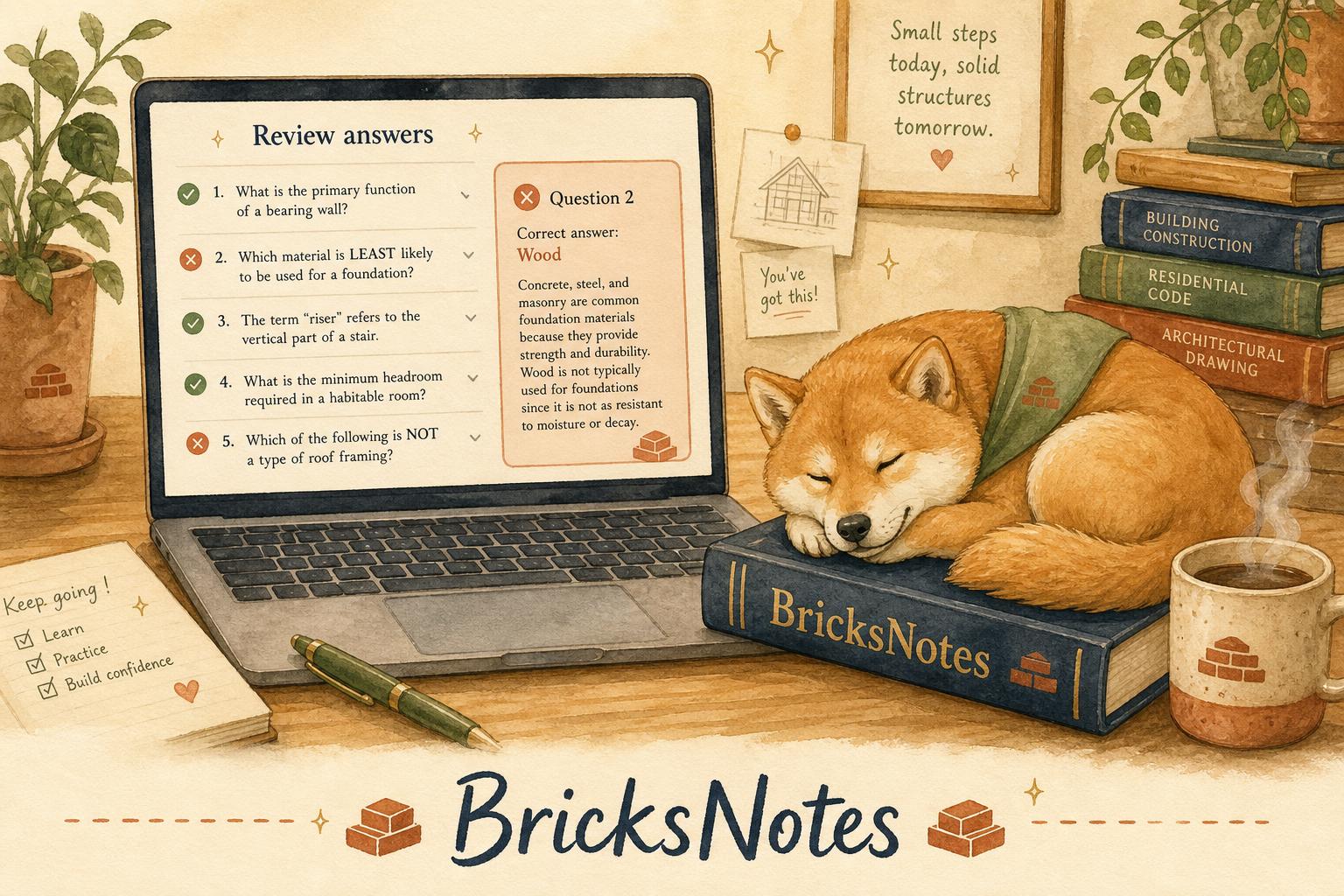
This was the biggest single unlock. On the first two attempts I looked at scores. On the third, I looked at my wrong answers, one by one, and read the explanation until I could re-explain it in my own voice.
The Review answers mode in the practice exam groups every miss by section and shows why the right answer is right. I stopped tracking my percentage. I tracked "questions I now actually understand." That number moved fast.
5. Read one chapter for each weak section
After each drill, whichever section was weakest got a real read from a book, not a doc dump. I used the BricksNotes book because chapters are short and end with an example I could run. If you want a calm, one-stop companion to the exam, the book is designed for exactly this loop.
One chapter, one notebook, one drill. Move on.
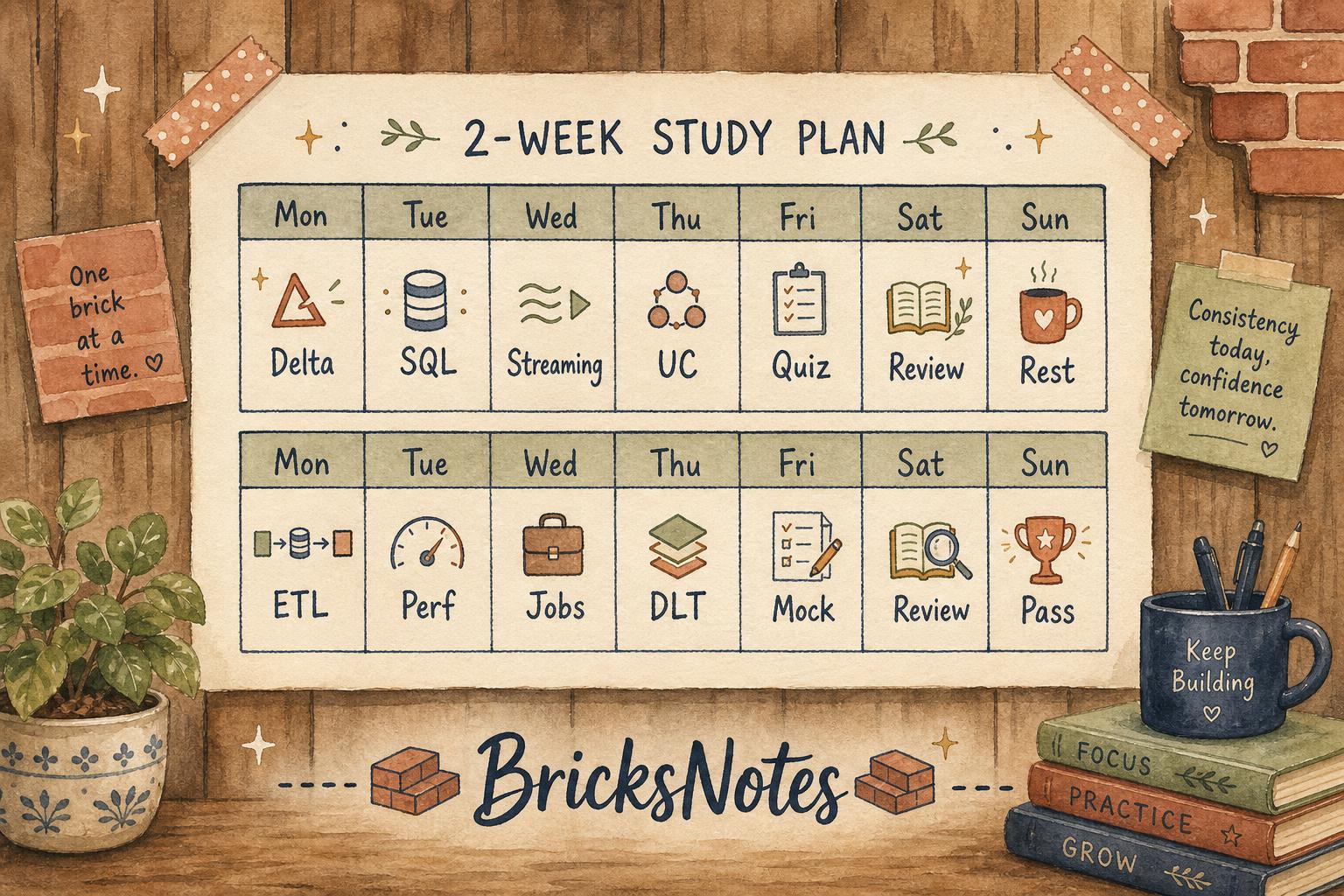
A simple two-week plan
This is the plan I actually followed. It assumes about an hour on weekdays and two hours on weekends. Nothing heroic.
Week 1: build the model
- Mon: Delta Lake basics. Read chapter, run one merge, do 15 questions.
- Tue: Spark and SQL. Run three joins, do 15 questions.
- Wed: Structured Streaming. Start one stream, watch it, do 15 questions.
- Thu: Unity Catalog. Create a catalog, do 15 questions.
- Fri: Quiz day. One section drill on your weakest area.
- Sat: Review every miss from the week. Re-run the ones that hurt.
- Sun: Rest. This is not optional.
Week 2: sharpen and simulate
- Mon: ETL patterns and incremental loads.
- Tue: Performance. Liquid Clustering, file sizes, Photon.
- Wed: Jobs and Lakeflow Declarative Pipelines.
- Thu: DLT-style pipelines, expectations, retries.
- Fri: One full mock, untimed. Note weak spots, not the score.
- Sat: Focused drills on those weak spots. Re-read one chapter each.
- Sun: Rest, light re-read of your own notes, sleep early.
You do not need more than this. You need to actually do this.
What I would tell my past self
You are not behind. You are not slow. You just read too much and ran too little.
Close the tabs. Open a notebook. Write one paragraph in your own words. Run one query. Miss one question. Read why. Do it again tomorrow.
The third attempt did not feel like a fight. It felt like the exam was asking about things I had already done. That is the whole trick.
If you are getting ready to retake, start with a section drill, see where you actually stand, and build from there. And if you want the calm, chapter-by-chapter companion I wish I had on attempt one, the BricksNotes book is exactly that.
You've got this. One brick at a time.
◆