The new Databricks Context Engineer Associate, explained for data engineers
A calm look at what this certification tests, why it exists, and why your data engineering habits already put you ahead
Most certification news is about a tool. This one is about a habit.
Databricks now has a Context Engineer Associate certification. It does not test how well you can pick a model. It tests how well you can build the information environment around one. That is a different skill, and it is closer to data engineering than to prompt writing.
If you already spend your days on tables, definitions, permissions and lineage, you are further along than you probably think.
A certification that is not about models
For the last couple of years, the interesting question was which model to use. That question is mostly settled. Models are good, they are cheap enough, and they are easy to swap.
The hard part moved somewhere else. An agent can only reason about what it can see at the moment it runs. If it sees stale numbers, it gives stale answers. If it cannot see the definition of active customer, it invents one. If it has no memory, it starts every conversation from zero.
None of that is a model problem. It is a data problem wearing a new hat.
That is what this certification is testing. It treats context as something you design and govern, not something you paste into a prompt box.
What context engineering actually means
Think of context as everything an agent receives before it answers.
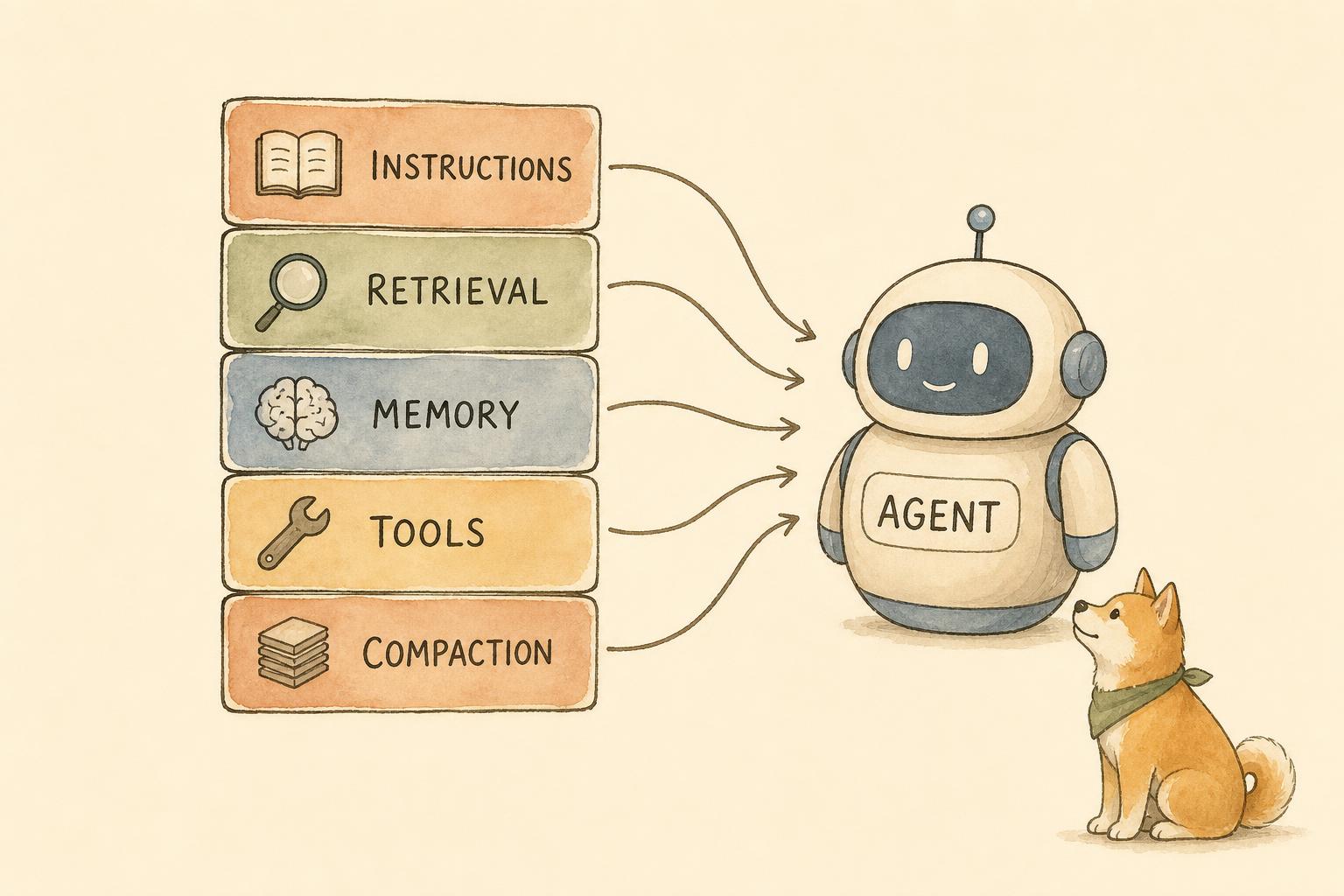
There are five pieces, and each one is an engineering decision.
Instructions are the durable rules. Who the agent is, what it must refuse, what shape its output takes. These belong in something versioned, not in a prompt someone edited last Tuesday.
Retrieval is what the agent can look up. Which tables, which documents, which chunks, filtered by which metadata. This is where Unity Catalog matters, because retrieval without permissions is a leak waiting to happen.
Memory is what survives between turns and between sessions. Short-term state inside a conversation, long-term state stored somewhere real.
Tools are the actions the agent is allowed to take. A tool description is context too. A vague description produces a vague call.
Compaction is how you keep all of the above inside a token budget. Every extra token costs money and latency, and long context is not automatically better context.
The sixth piece is evaluation. If you change any of the five and cannot tell whether the change helped, you are guessing.
The seven domains, in normal words
Databricks publishes seven sections with weights. Here they are, translated.
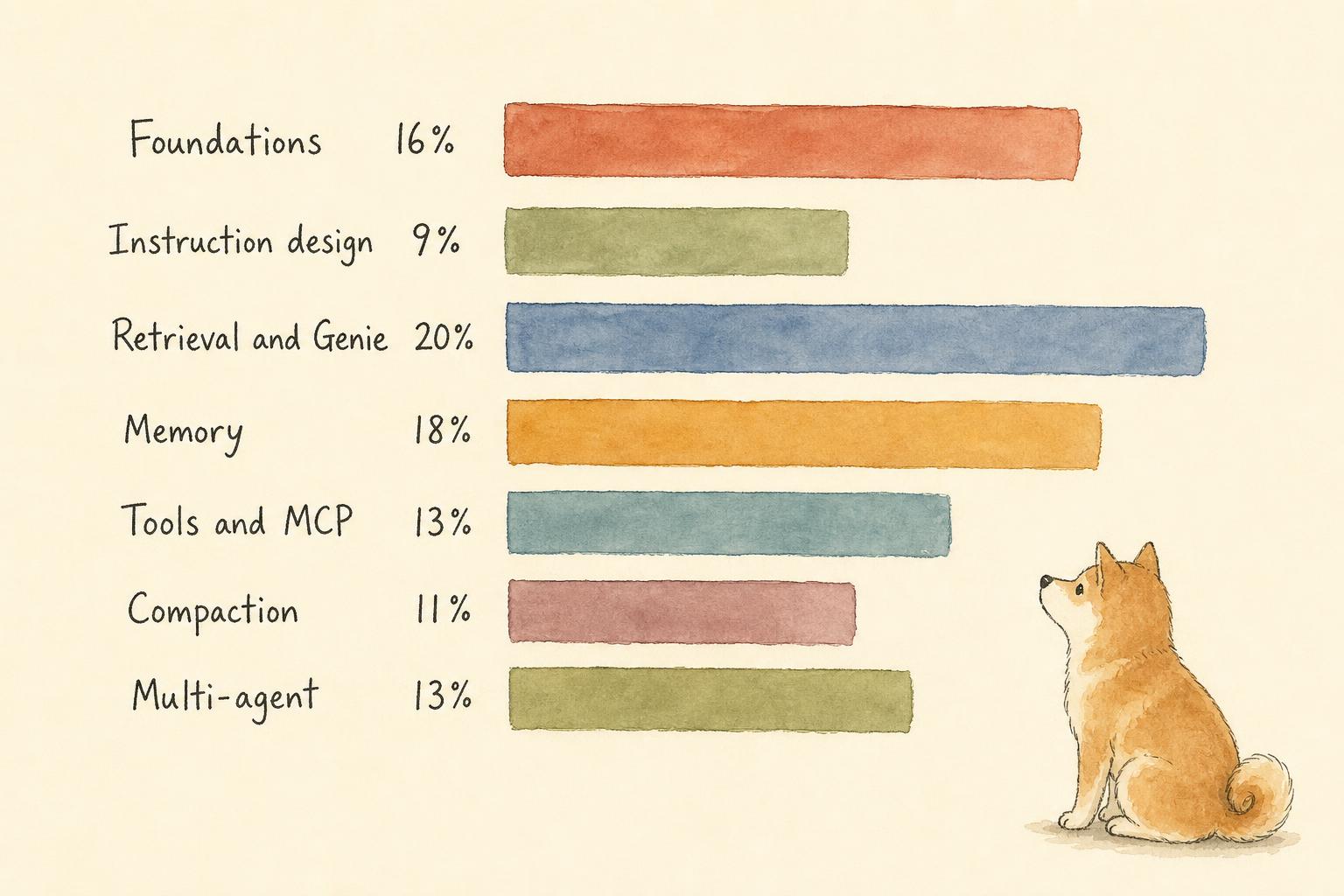
Foundations, 16 percent. What context engineering is, and how it differs from prompt engineering. Mostly vocabulary and framing, but the framing carries the rest of the exam.
Instruction design, 9 percent. Writing durable system prompts, output contracts and refusal behaviour. The smallest section, and the easiest to underestimate.
Retrieval and Genie, 20 percent. The largest section. Vector Search, Genie spaces, chunking, metadata filters, hybrid search, grounding, citations and governed access. If you only have time for one area, start here.
Memory, 18 percent. Short-term versus long-term memory, session state, and using MLflow to trace and evaluate what the agent actually saw.
Tools and MCP, 13 percent. Unity Catalog functions, MCP servers, parameter design and permissions. This is API design with a governance layer on top.
Compaction, 11 percent. Trimming, summarising, checkpoints, token budgets, and where in the window information lands.
Multi-agent and long-horizon tasks, 13 percent. Handoffs between agents, supervisor patterns, isolation boundaries and long-running state.
Notice the shape. Retrieval and memory together are 38 percent of the exam. Both are storage and governance problems.
Why data engineers are already halfway there
Read that list again with your day job in mind.
Retrieval is a join with permissions. Memory is a table with a retention policy. Tool design is a contract between systems. Compaction is a cost optimisation problem, the same instinct that makes you avoid scanning a whole table when a filter would do.
You also already own the thing that makes agents useful and nobody else wants to maintain: the meaning of the data. Which column is authoritative. What a metric actually counts. Which table is safe to expose and to whom. An agent inherits your definitions, good or bad.
Governance is the other advantage. Teams that skip straight to agent building usually discover permissions three months in, after something leaked. If you have already set up Unity Catalog properly, that section of the work is behind you.
The gap for most data engineers is not the data side. It is the agent vocabulary: what a context window really costs, how tracing works, what a supervisor pattern is for.
What to study, and in what order
A sensible sequence if you are starting from a data background.
Start with Unity Catalog, because every other domain assumes it. Catalogs, schemas, volumes, grants, lineage. Our Unity Catalog lesson covers the model in plain terms.
Then learn Genie and Vector Search hands on. Build one small Genie space over a table you know well, and watch where it gets confused. Those confusions are the exam questions.
Then read about MLflow tracing. Not the model registry part, the trace part. Seeing exactly what an agent received is how you debug context.
Then look at Lakebase for session state, and Unity Catalog functions plus MCP for tools.
Leave compaction and multi-agent for last. They make more sense once you have watched a single agent misbehave.
Throughout, keep building real pipelines. A well structured medallion layout is what makes retrieval trustworthy in the first place.
Where to practise
For the data engineering certifications, our own Associate practice exam is free and covers the exam guide domain by domain.
For this new certification, the most complete resource we have seen is the free Databricks Context Engineer Associate practice exam from The Context Advantage. It has 395 original scenario questions, a 45 question timed mock in 90 minutes, explanations on every option, and per domain scoring that points you at what to read next. We did not build it and we do not earn anything from it. We are linking it because it is genuinely the best thing available for this exam right now, and it is free.
If you want the deeper reasoning behind the discipline itself, The Context Advantage book is worth reading alongside the practice questions. We also keep a short summary of the ideas on our own Context Advantage page.
The short version
This certification is a signal. The industry is finally naming the work that data people have been doing quietly for years, and pricing it as an AI skill.
You do not need to become an ML engineer to be good at it. You need to understand where information lives, who is allowed to see it, what it means, and what it costs to move. That is your job already.
Continue learning
- Unity Catalog, explained simply
- Medallion architecture in practice
- Free Databricks Associate practice exam
- Context Advantage on BricksNotes
- Thinking in Data Engineering with Databricks
Related reading: Context engineering is becoming a real job skill for data engineers.