Your next assistant is an agent. And it runs on data
By the end of 2026, personal agents will handle the tasks we do on our phones and computers. Every one of them runs on data someone made trustworthy. Here is what that means for the agent era, and for you.
Your next assistant is an agent. And it runs on data
There is a sentence making the rounds right now, and it is worth reading slowly:
"By the end of 2026, we will have super-capable AI assistants: personal agents irresistibly good at performing all the tasks we do on our phones and computers."
Sit with that for a moment. Not a chatbot that answers questions. An agent that does the work. It books the trip, reschedules the meeting, reconciles the expense report, follows up on the invoice, and drafts the weekly summary before you have finished your coffee.
Some people read that sentence and feel excited. Some feel nervous. Both reactions are reasonable. But whatever you feel, here is the part that matters for anyone building a career in data and AI: every one of those agents runs on data. Not on magic. Not on vibes. On data that someone collected, cleaned, organized, and kept trustworthy.
That someone is a data engineer. And that someone could be you.
What a personal agent actually does all day
It helps to make this concrete. Imagine your personal agent on an ordinary Tuesday morning in late 2026.
It notices your flight got moved and rebooks it against your calendar. It reads the team's overnight sales numbers and flags that one region dropped 15 percent. It pays a vendor invoice, but holds it first because the amount does not match the purchase order. It drafts three replies in your voice, each grounded in the actual documents and threads they belong to.
Now look at what is really happening underneath. Every single action required the agent to answer a small question with confidence. What is my current flight? What were sales yesterday, by region, deduplicated? What did we agree to pay this vendor? What did I say last time?
Those are data questions. All of them. An agent is only as good as the data underneath it, and the difference between a magical assistant and a dangerous one is almost never the model. It is whether the numbers it reads are fresh, correct, and unambiguous.
The agent is the tip. The data is the iceberg
When people imagine AI agents, they picture the tip of the iceberg: the friendly interface, the confident answer, the task checked off. What they do not picture is the enormous structure below the waterline.
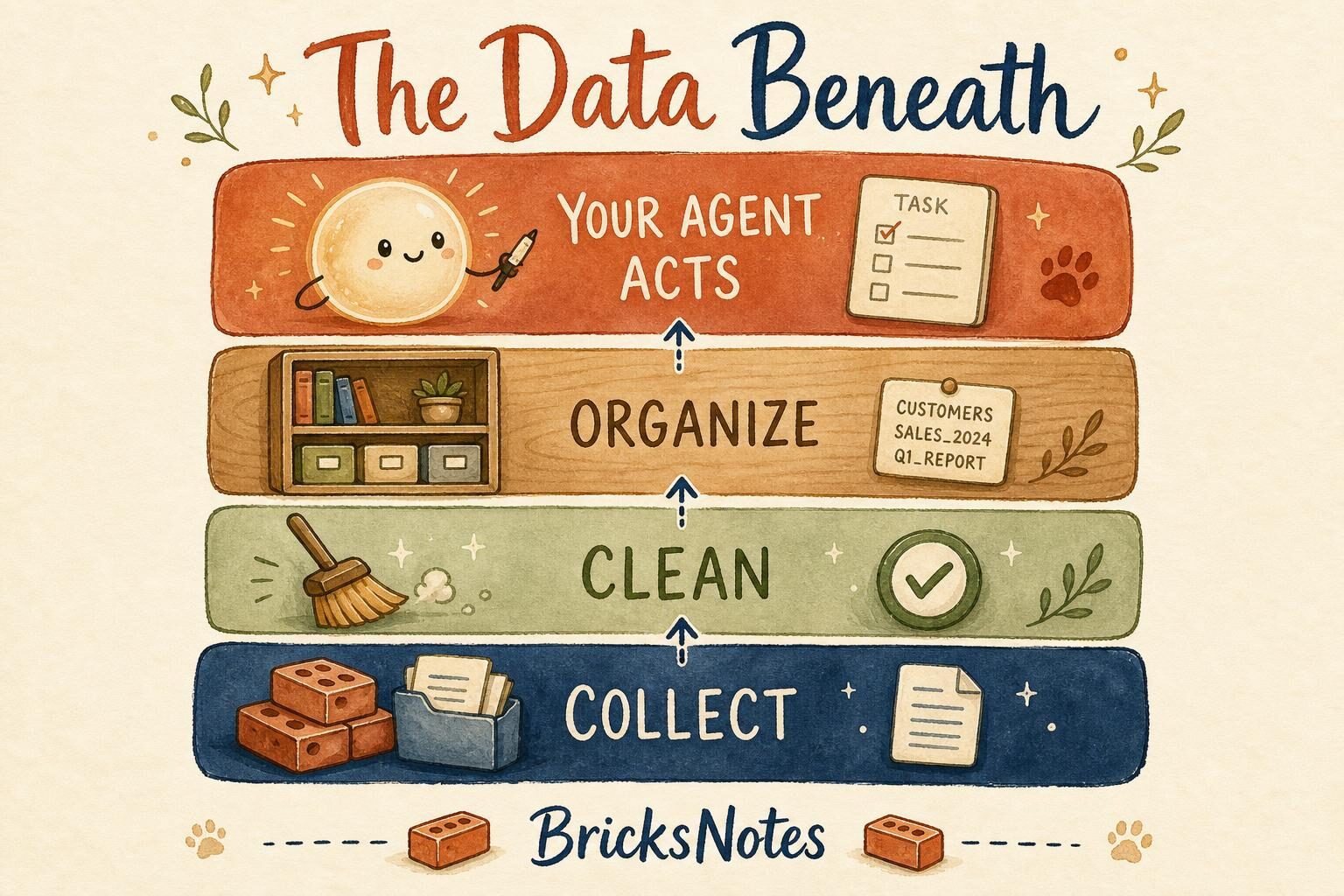
That structure has a shape you already know. Raw events and files land first, messy and duplicated. Someone cleans them into tables you can trust. Someone organizes those tables into clear, well named entities with ownership and meaning. Only then can an agent act on them safely.
This is the medallion pattern that data teams have used for years: bronze, silver, gold. We wrote a full explainer on medallion architecture if you want the gentle version. The point here is simpler: agents did not replace this work. Agents made this work matter more. A wrong number in a dashboard annoys a human. A wrong number handed to an agent becomes a wrong action taken at scale, on your behalf, while you sleep.
Why agents raise the bar for data quality
Here is the uncomfortable truth about agents. They do not pause. A human analyst sees a strange row and asks a question. An agent sees a strange row and acts on it, confidently, a thousand times.
This changes the economics of data quality completely. Small issues that used to be rounding errors are now amplified. A duplicated customer record becomes two welcome emails and two invoices. A stale exchange rate becomes a systematically wrong price. A schema change nobody documented becomes an agent silently reading the wrong column for a week.
This is why we keep saying the next phase of data engineering is not faster pipelines but faster decisions, and why we keep teaching data quality checks as a first-class skill rather than an afterthought. In the agent era, quality is not hygiene. Quality is safety.
The good news: you already know where to start
If this all sounds big and futuristic, here is the calming part. The skills that make agents work are the same skills we teach every day, in the same order.
Start with the foundations. Our start here lesson gets you a working Databricks Free Edition workspace in an afternoon, no credit card, no enterprise anything. Then learn the storage layer that agents will actually read from: Delta Lake, where reliability features like ACID transactions and time travel are not luxuries but the reason an agent can trust what it reads. From there, medallion architecture teaches you to organize raw chaos into clean, purposeful layers, and data quality teaches you to prove the numbers are right before anyone, human or agent, acts on them.
Once the foundations hold, the agent-facing pieces click into place naturally. Genie Spaces is literally a preview of this future: a well curated set of tables with good descriptions that an AI can reason over. AI Gateway and serving shows how models get wired to governed data instead of loose files. None of this requires a paid workspace to learn. It requires curiosity and a few evenings.
What the agent era means for your career
Let us be direct, because this question deserves a straight answer. Will agents replace data engineers?
Agents will absolutely replace some tasks. Writing the fifteenth variation of the same SQL query. Hand-checking row counts. Rebuilding a table after a schema change. Good. Those were never the job. Those were the chores around the job.
The job, the real one, is deciding what the data should mean. Which sources are authoritative. What "a customer" actually is. What quality bar a table must meet before an agent may touch it. What the agent is allowed to do, and what it must never do. These are judgment calls, and they are getting more valuable every month, not less. We wrote about this shift in databases built for agents and in our piece on data agents and the next decade. The pattern is consistent: the people who understand data deeply are the ones who get to design the systems everyone else uses.
The quote at the top of this article is a promise about assistants. Read it again as a promise about careers. A world full of agents is a world with insatiable demand for people who can build and guard the data those agents depend on.
Our vision, and why we wrote a book
This is the future BricksNotes is built for. Not the hype version, the practical one.
Our vision is simple. The golden era of data and AI will be built by ordinary people who understand systems deeply, not by a small priesthood who memorized tools. So everything we make follows the same philosophy: start with intuition, explain why before how, practice on real infrastructure you can access for free, and build upward one honest layer at a time.
That is the whole shape of our book, Thinking in Data Engineering with Databricks. It does not chase frameworks. It teaches you to think: how data moves, where it breaks, how to make it trustworthy, and how to grow from your first table to systems that agents and businesses can depend on. The first three lessons are free, because the best way to know if this path is for you is to walk the first few steps of it.
If the agent era excites you, the book is your foundation. If it makes you nervous, the book is your anchor. Either way, the future belongs to the people who understand the data underneath.
Three small things to do tonight
Big futures are built from small evenings. Here are three.
Open a free Databricks workspace and create your first Delta table. Just one. Feel what a reliable table is.
Take one dataset you use, at work or in a side project, and write down its three biggest quality risks. Duplicates? Staleness? Undefined columns? That list is the beginning of an agent-readiness review.
Read one article on how agents consume data, then ask yourself: if an agent read my tables tomorrow, would it act correctly? If the answer is "I am not sure," you have found your next learning goal.
The assistants are coming. The agents are coming. And behind every one of them, quietly doing the work that makes the magic possible, there is a data engineer.
We would love for that to be you. See you in the lessons.