One agent is easy. Managing a fleet of them is the real job.
Most enterprises already run two or more AI coding tools. The harder part is running that growing fleet without creating new silos. Choice, Context, and Control are the three decisions that make it scale.
A year ago, most teams were asking a simple question: should we try an AI coding tool?
That question is settled. Today, many enterprises already run two or more AI coding tools. One team uses a coding assistant in the IDE. Another experiments with an agent that writes pipeline code. A third has a chatbot that answers questions about internal data.
The tools work. That is not the problem anymore.
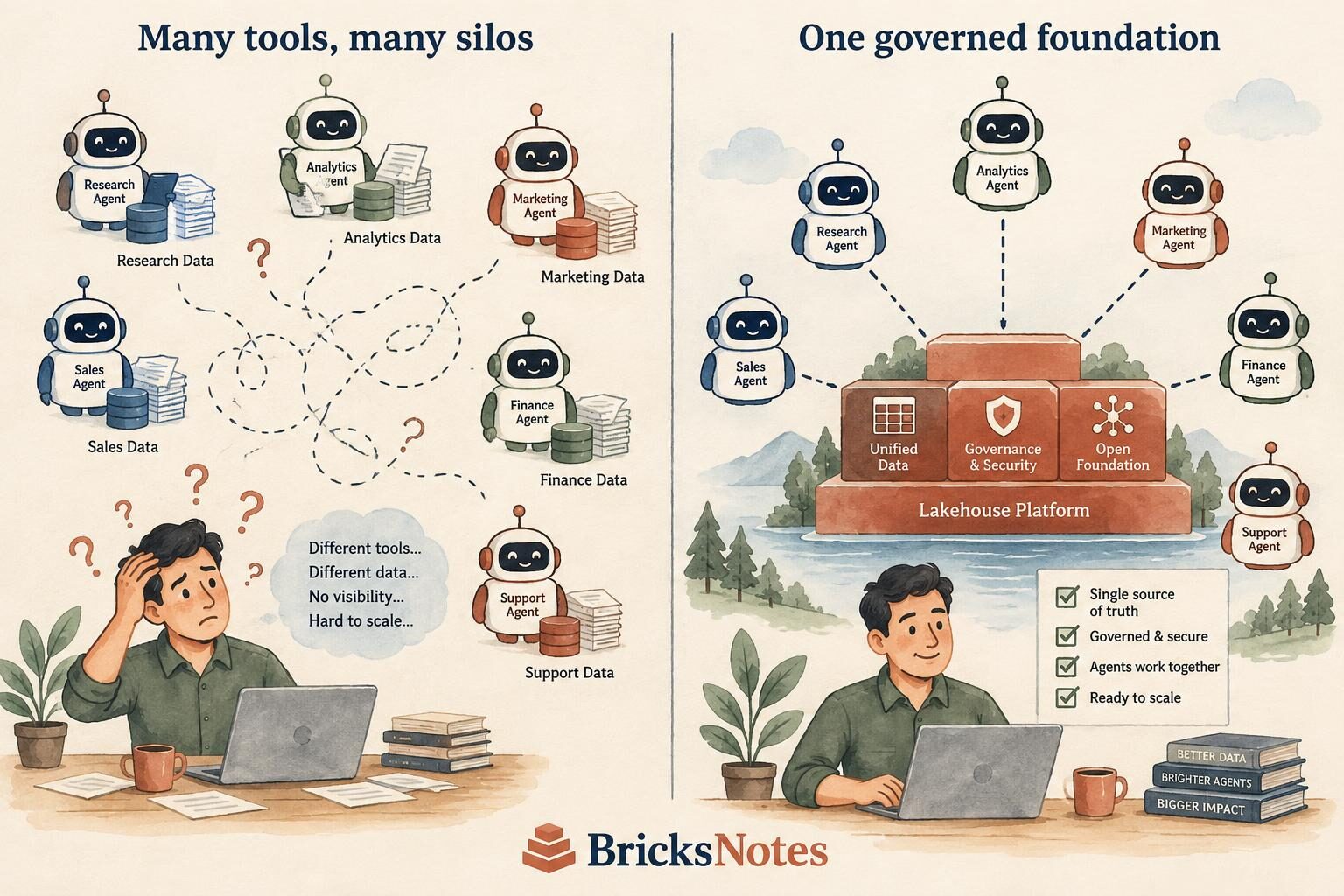
The harder part is managing this growing fleet without adding more silos and less visibility. Every new tool brings its own context, its own permissions, its own idea of the truth. Left alone, you do not get an AI-powered organization. You get ten small ones that cannot see each other.
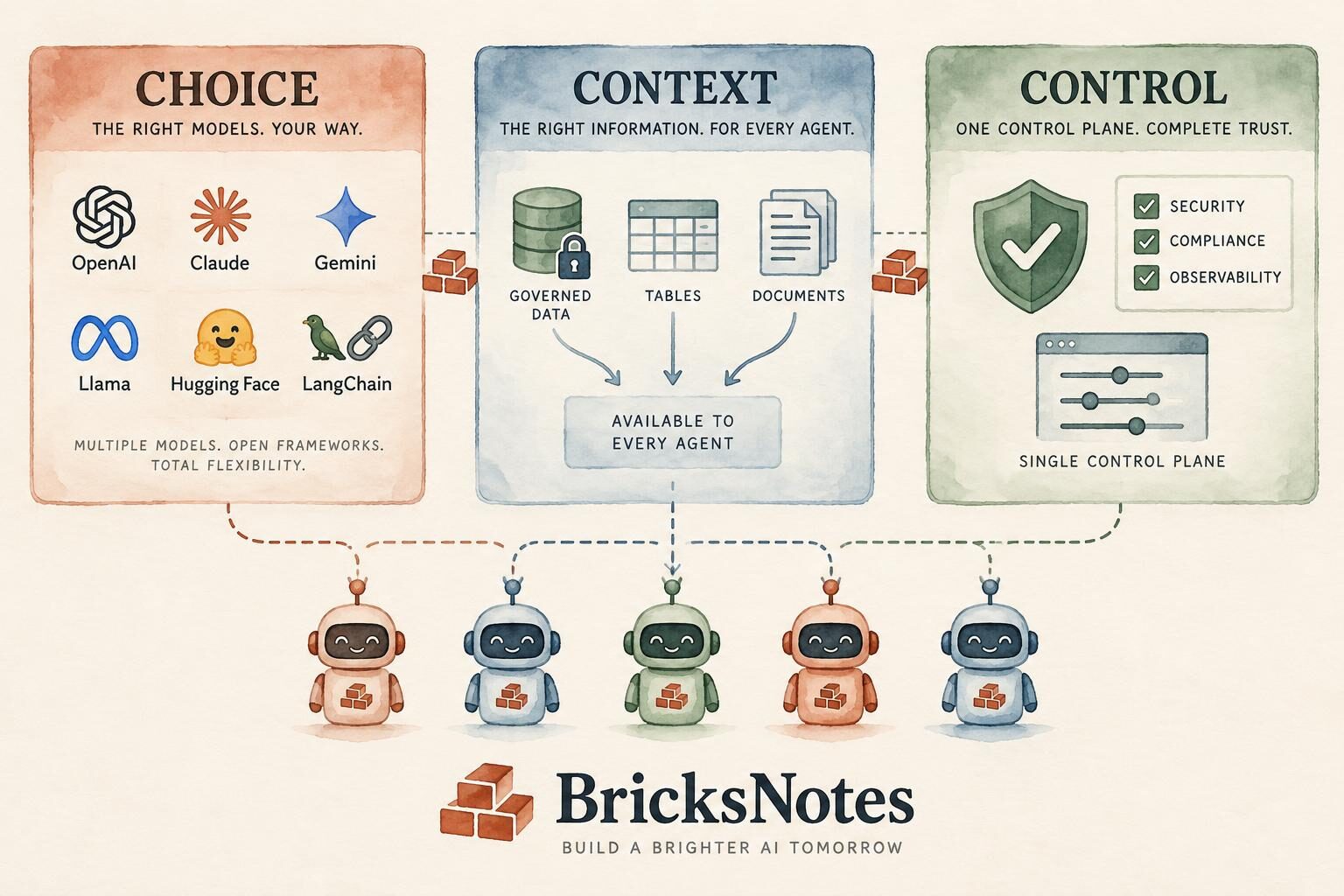
This article is about a calmer way to think about it. It comes down to three decisions: Choice, Context, and Control.
Watch the explainer
https://youtu.be/LpH8FOeM-F8
The quiet shift from one tool to a fleet
Nobody plans to end up with five AI tools. It happens naturally.
A team picks the assistant that fits their editor. Another team picks the one that fits their cloud. Procurement adds a second vendor to keep pricing honest. A new framework becomes popular and someone wants to try it.
Each decision is reasonable on its own. Together, they create a fleet.
And a fleet is a different kind of problem than a single tool. A single tool needs a good prompt. A fleet needs shared ground: the same understanding of your data, the same rules about what is allowed, and a single place to see what every agent is doing.
Without that shared ground, every new agent makes the whole system a little less visible, not a little more capable.
Decision one: Choice
Choice means you can build and run agents on any model, harness, or framework.
This sounds like a luxury. It is actually a survival strategy.
Models improve on different schedules. The best model for SQL generation this quarter may not be the best model for document summarization next quarter. Open frameworks move fast, and your teams will want to use them.
If your agents are welded to one vendor, every improvement elsewhere becomes a migration project. If your platform treats models as interchangeable parts, switching is a configuration change, not a quarter of work.
Choice is not about having more tools. It is about never being trapped by the ones you have.
On Databricks, this is what it means to serve multiple models side by side through AI Gateway and Model Serving, and to build agents with open frameworks while the platform handles the routing, logging, and fallback behind a single endpoint. We walk through this hands-on in the AI Gateway and Serving lesson, where you set up a governed endpoint in a Free Edition workspace.
Decision two: Context
Context means every agent is grounded in the same governed context.
Here is a story we see often. Two agents answer the same business question differently. Not because one model is smarter, but because each was given a different slice of the company's data. One read last quarter's export. The other read the live table. Both sounded confident.
The fix is not a better prompt. The fix is a shared, governed context: the same tables, the same definitions, the same documents, with the same permissions applied everywhere.
This is exactly what Unity Catalog provides on the data side. Tables, views, volumes, and functions live in one catalog with one permission model. When every agent reads through that catalog, two good things happen at once. Agents agree with each other, and agents can never see more than the people who own them are allowed to see.
If you want the foundation, start with the Unity Catalog lesson. It is the single most important concept for grounding agents safely.
This idea goes far beyond one platform. Our sister book, The Context Advantage, is built entirely around it: Context, Control, Cost, and Choice are the four decisions that determine whether AI actually works inside a company. Context is the one everything else stands on.
Decision three: Control
Control means you govern models, tools, MCP servers, skills, and agents through one control plane.
Choice and Context without Control is just a bigger mess, faster.
Control answers the questions that show up the moment agents touch real work. Which models is this agent allowed to call? Which tools and MCP servers can it use? What did it actually do last Tuesday when the numbers looked wrong? Who approved giving it write access?
When each tool answers these questions in its own admin panel, visibility drops as adoption grows. When one control plane answers them for every agent, visibility grows with adoption instead.
On Databricks, this control plane is the same one that already governs your data. Unity Catalog governs the tables and functions agents use as tools. AI Gateway governs the model endpoints: rate limits, usage tracking, guardrails, and fallbacks in one place. MLflow tracing shows what an agent did, step by step, when you need to debug or audit.
The goal is not to slow agents down. It is to make "what is every agent doing right now?" a question with one answer.
Why this is a data engineering story
You might notice something. None of these three decisions are really about models.
Choice is about architecture. Context is about governed data. Control is about a control plane. These are data engineering concerns, wearing new clothes.
That is good news if you are a data engineer. The skills you have been building, catalogs, permissions, pipelines, quality, and observability, are exactly the skills a fleet of agents needs. The data quality lesson you practiced for dashboards is the same discipline that keeps an agent from quoting a broken table. The medallion flow from our medallion architecture article is the same structure that gives agents clean, reliable gold-layer answers.
If you are newer here and want the full foundation, Start Here is the front door, and the BricksNotes book walks the whole path from workspace basics to governed AI, one calm lesson at a time.
A simple test for your own organization
Here is a practical way to use this framework this week.
Pick one agent your company runs. Ask three questions.
Could we swap its model for a better one without a migration project? That is Choice.
Does it read from the same governed tables and documents as everything else, or from its own private copy? That is Context.
Can I see what it did, what it called, and what it cost, in the same place I see every other agent? That is Control.
If any answer is no, you have found the next thing worth fixing. And it is usually cheaper to fix now, with a fleet of five, than later, with a fleet of fifty.
Where this leaves us
The first era of enterprise AI was about getting one tool to work. The next era is about getting many agents to work together, on shared ground, under shared rules.
Choice keeps you free. Context keeps agents honest. Control keeps you in charge.
None of it requires hype. It requires the same calm, unglamorous work data engineers have always done: one catalog, one permission model, one place to see what is happening.
Brick by brick.