Genie One, explained simply: the AI coworker that already knows your data
What it does, how it works, where it fits, and what it will never do for you
Someone in your company already knows the answer to the question your director just asked. The problem is that the answer lives in a table, the table lives in a catalog, and the person asking has never written a join in their life.
So the question travels. It becomes a message, then a ticket, then a small task on someone's Monday. Two days later a number comes back, and by then the decision has already been made without it.
Genie One is Databricks' attempt to shorten that trip. Not by making the question smarter, but by putting something between the person and the data that can read both.
What Genie One actually is
You may already know Genie Spaces. You pick a set of tables, and people ask questions in plain language. Genie writes the SQL, runs it, and shows the answer along with the query it used.
Genie One is the next step in that idea. Instead of a query box you visit, it behaves more like a coworker who happens to be very good with data. It can answer a question, explain how it reached the answer, and then take a next action, such as starting a workflow or posting a summary where your team already works.
The word that matters is coworker. A query box waits for you. A coworker follows up.
Genie One is available in paid Databricks workspaces. Genie features are not part of Free Edition. The thinking in this article still applies, and everything you need to prepare for it can be practiced in Free Edition.
From a question to an answer, step by step
It helps to see the path clearly, because every step is a place where things can go right or wrong.
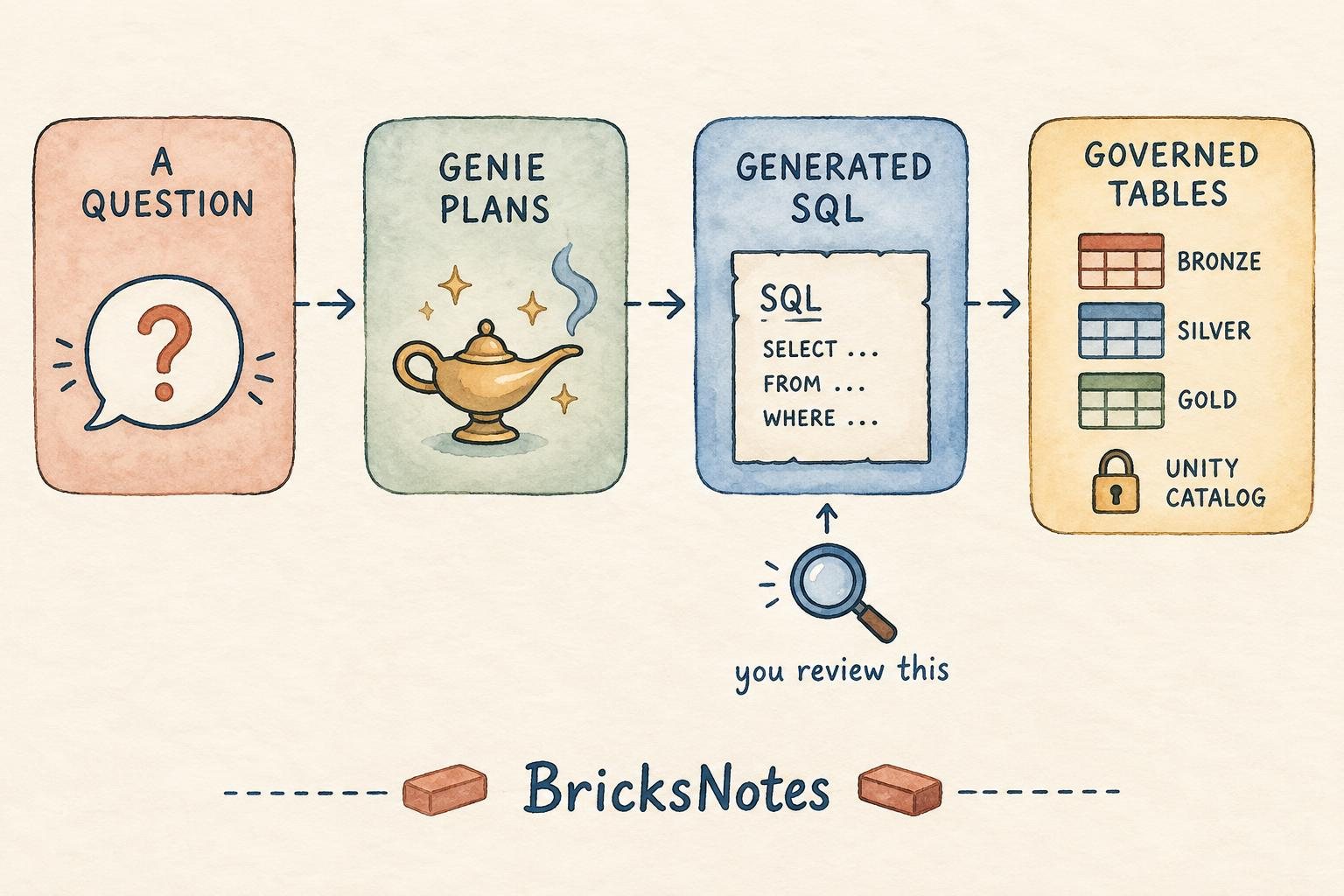
First, someone asks a question in normal language. Something like "which region lost the most repeat customers last quarter".
Second, Genie plans. It looks at the tables it has been given, the column names, the descriptions, the relationships, and any example questions you provided. This is where context does the heavy lifting.
Third, it writes SQL. Real, readable SQL against real tables. This is the part most people skip past, and it is the part you should never skip.
Fourth, it runs that SQL against your governed tables. Permissions still apply. If the person asking cannot see salary data, Genie cannot show them salary data on their behalf.
The answer that comes back is only as good as the tables underneath it. That is not a limitation of Genie. That is just how data works.
Why context is the real work
Here is the uncomfortable truth about every natural language data tool. The model is rarely the bottleneck. Your table names are.
A column called flg_2 means nothing to a language model, because it means nothing to a human either. A table named cust_final_v3_new tells Genie that somebody gave up, not what the data contains.
Good answers come from boring discipline. Clear table and column names. Written descriptions. A small set of trusted gold tables rather than every raw file you own. A handful of example questions that show the shape of how your business asks things.
You can start today, even in Free Edition, with plain SQL comments:
COMMENT ON TABLE workspace.default.gold_customer_orders IS
  'One row per customer per month. Trusted for revenue reporting.';

COMMENT ON COLUMN workspace.default.gold_customer_orders.is_repeat_customer IS
  'True when the customer ordered in a previous month.';
That is not glamorous work. It is also the single highest return thing you can do before any AI touches your data.
Watch the explainer
https://youtu.be/raIsUywRlQ8
What it can do, and what you still own
The honest framing keeps everyone calm. Genie One shortens the distance between a question and an answer. It does not take over your judgement.
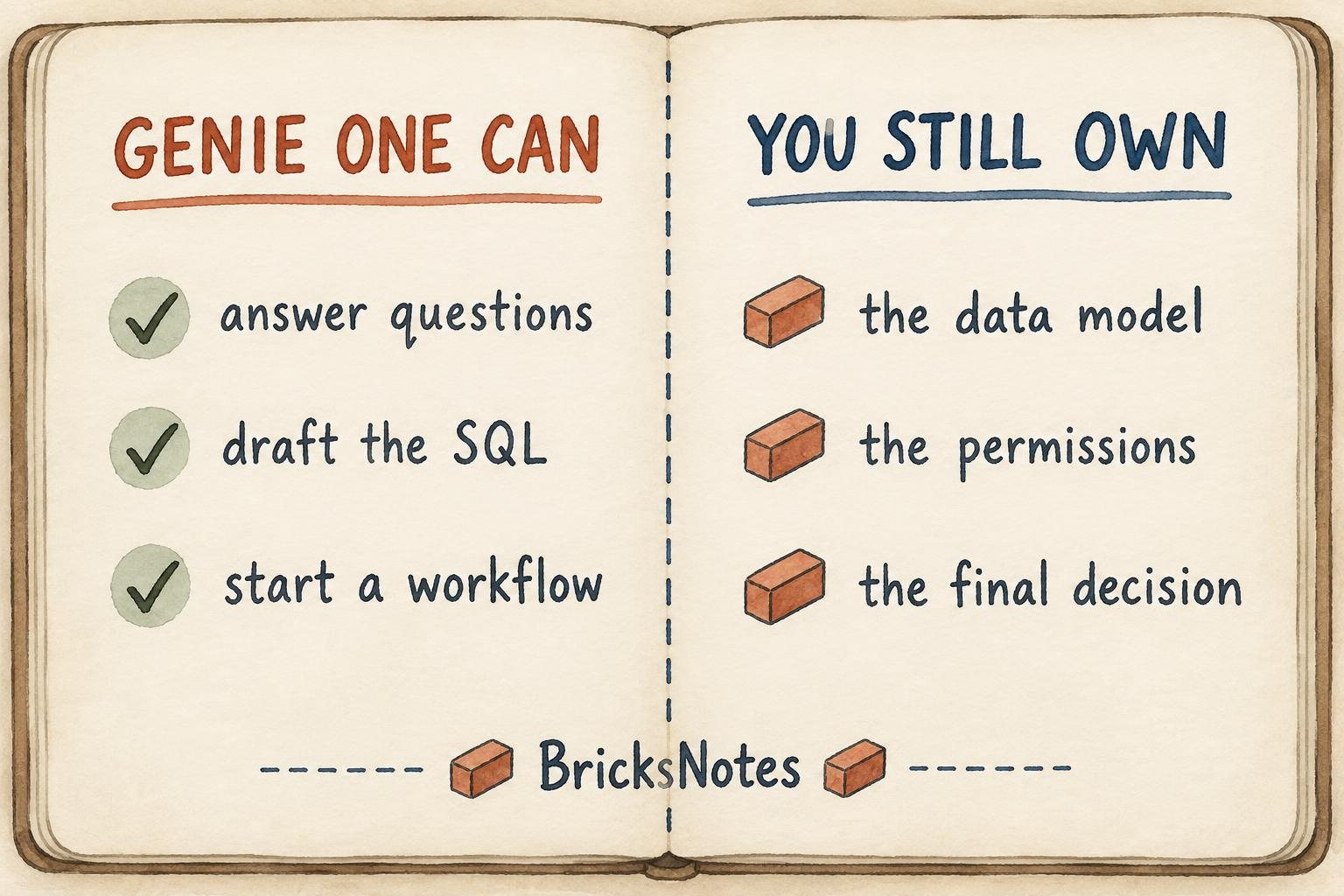
Genie One can answer questions, draft the SQL, explain its reasoning, and start a follow up action.
You still own the data model, the definition of a metric, the permissions, and the final decision. If your definition of "active customer" is fuzzy, Genie will confidently give you a fuzzy number. It cannot decide what your business means.
There is also a distinction worth holding on to. What an agent remembers is not the same as what your business systems say is true. We wrote about that separately in your AI agent remembers the refund, the business still says pending, and it applies here too. An answer in a chat window is not a state change in a system of record.
Where it fits in your architecture
Point Genie at gold, not bronze.
Bronze is raw. Silver is cleaned and conformed. Gold is where meaning lives, where a metric has one agreed definition and one place to read it from. That is the layer a conversational tool should sit on.
If you let a natural language tool roam across raw landing tables, you will get answers that are technically correct and practically wrong. Two tables, two definitions of revenue, two different numbers on the same slide.
Unity Catalog is what makes this safe rather than scary. Permissions, row filters, lineage, and audit history are not optional extras when a tool can act. They are the reason you can let it act at all.
A small habit that prevents most problems
Read the SQL.
Genie shows you the query it wrote. Reading it takes fifteen seconds and answers the only question that matters: does this query mean what I think the answer means.
Once, on a project, a dashboard reported a beautiful jump in new customers. The query was fine. It counted rows in a table that had been loaded twice. The tool did nothing wrong. Nobody read the SQL.
Treat every generated answer as a fast first draft. For a curiosity, that is plenty. For a decision, verify it against a trusted table before it reaches a slide.
Honest limits
Genie One is not a replacement for a data engineer, and it is not magic on top of a mess.
It will struggle when your naming is unclear, when the same concept exists in five tables, when nobody has written down what a metric means, or when late arriving data quietly changes yesterday's numbers.
Every one of those is a data engineering problem, not an AI problem. Which is good news, because those problems are learnable.
Where to learn the foundations
If Genie One interests you, the useful move is not to study Genie. It is to build the foundation that makes Genie trustworthy.
Start with Genie Spaces to see the conversational layer up close. Then go under it. Unity Catalog covers governance, permissions, and three part naming. Medallion architecture covers why gold tables exist. Data quality covers the checks that stop bad numbers early. Delta Lake covers history and time travel, which is how you explain what changed and when. And Spark SQL sharpens the skill you need most when reading generated queries.
Those chapters are part of the BricksNotes book, Thinking in Data Engineering with Databricks. The whole book is built on one idea: understand the system, and the tools stop being intimidating.
Continue learning
- Databricks Genie: the AI layer that turns your lakehouse into a conversation
- Genie One goes mobile: what it means for data teams
- Genie Code and what it means for data engineers
- Your AI agent remembers the refund. The business still says pending.
The tools will keep changing names. The habit that keeps you valuable is quieter than that. Ask a clear question, read the query, understand the table underneath. Brick by brick.