How to Become an AI Data Engineer in 2026
A calm, practical roadmap for building reliable data foundations, AI applications, and agent-ready systems.
AI does not remove the need for data engineers
There is a quiet worry in every data team right now. Will AI replace us? Should we drop everything and learn agents? Are pipelines still worth building?
Here is the honest answer. AI does not remove the need for data engineers. It raises the bar on the data foundation underneath. Every reliable AI product sits on top of data that someone made trustworthy. That someone is a data engineer.
What is changing is the shape of the role. A new branch is forming next to traditional data engineering. Call it the AI data engineer. It is the engineer who makes organizational data reliable, understandable, governed, and usable by both people and AI agents.
This guide is a calm, stage-based roadmap to that role. No 12-month promise. No hype. Just the four stages that matter and how to move through them at your own pace.
What is an AI data engineer?
It helps to see three roles side by side.
A traditional data engineer moves data from source systems into a warehouse or lakehouse. They care about pipelines, schemas, and freshness. Their job is done when the data lands correctly.
An ML engineer trains, deploys, and monitors models. They care about features, experiments, drift, and serving latency. They usually assume the data is already usable.
An AI data engineer sits between the two. They build the data foundation that AI systems actually depend on. They care about data quality, semantic meaning, governance, and whether an agent can safely act on the data. They do not train foundation models. They make sure the data those models read is worth reading.
The AI data engineer is not a promotion above data engineering. It is a widening of the same craft.
The four-layer AI data engineering skill stack
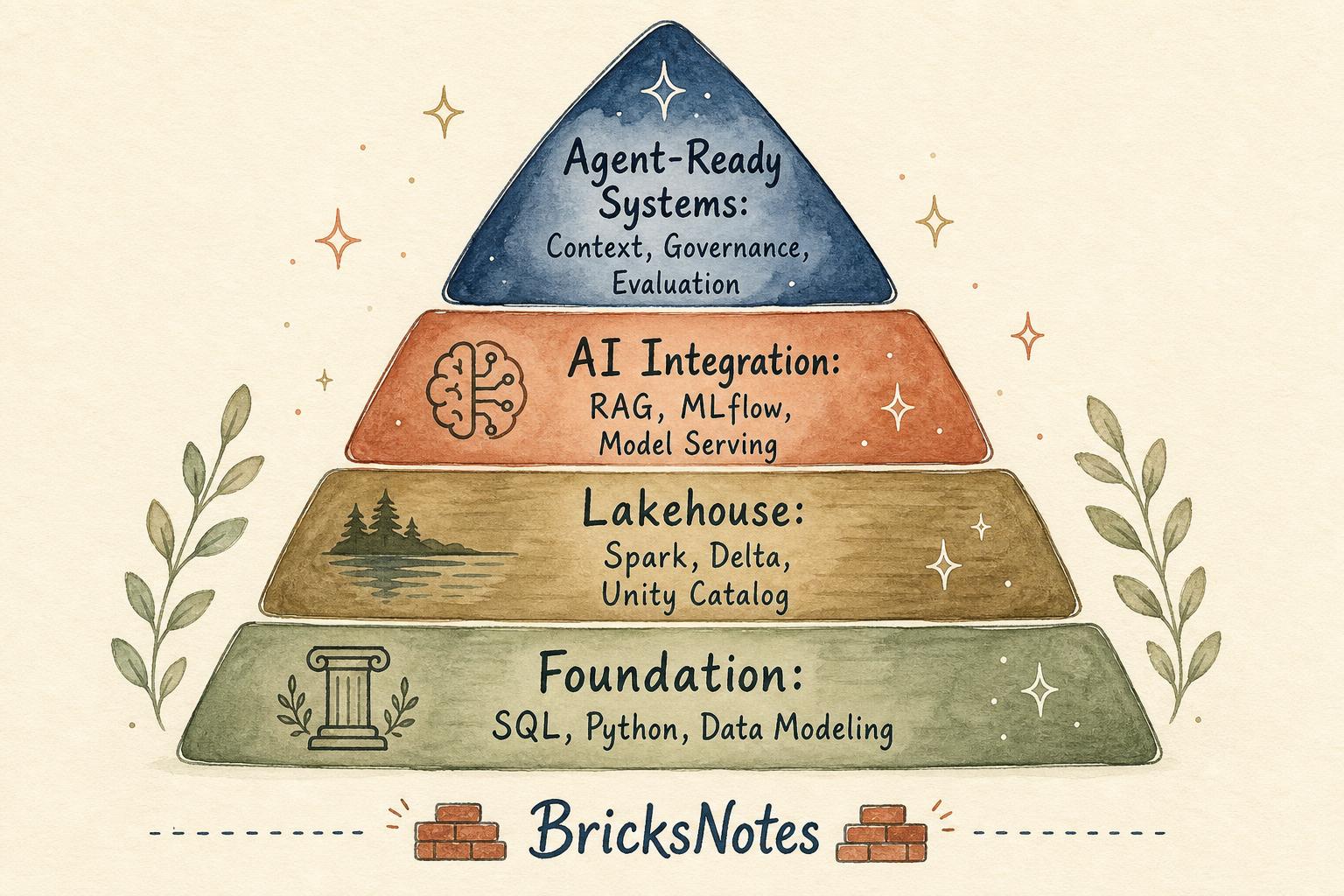
Every reliable AI data engineer builds four layers, in order.
Foundation. SQL, Python, data modeling, ETL patterns, testing, and data quality. This is the layer everything else stands on. Skip it and every layer above becomes shaky.
Lakehouse. Spark DataFrames, PySpark, Delta Lake, Lakeflow Jobs, Unity Catalog, monitoring, and optimization. This is where you turn raw files into reliable, governed tables.
AI integration. Document extraction, embeddings, vector search, Model Serving, MLflow, evaluation, and governed AI applications. This is where data starts feeding models and small AI features.
Agent-ready systems. Business context, semantic definitions, permissions, tool interfaces, memory, observability, cost controls, and human approval. This is where you make data safe for autonomous agents to use.
Notice what is not on this list. Foundation model training. GPU cluster tuning. Advanced deep learning math. Those belong to a different role. You can have a long, valuable AI data engineering career and never train a model from scratch.
A practical four-stage roadmap
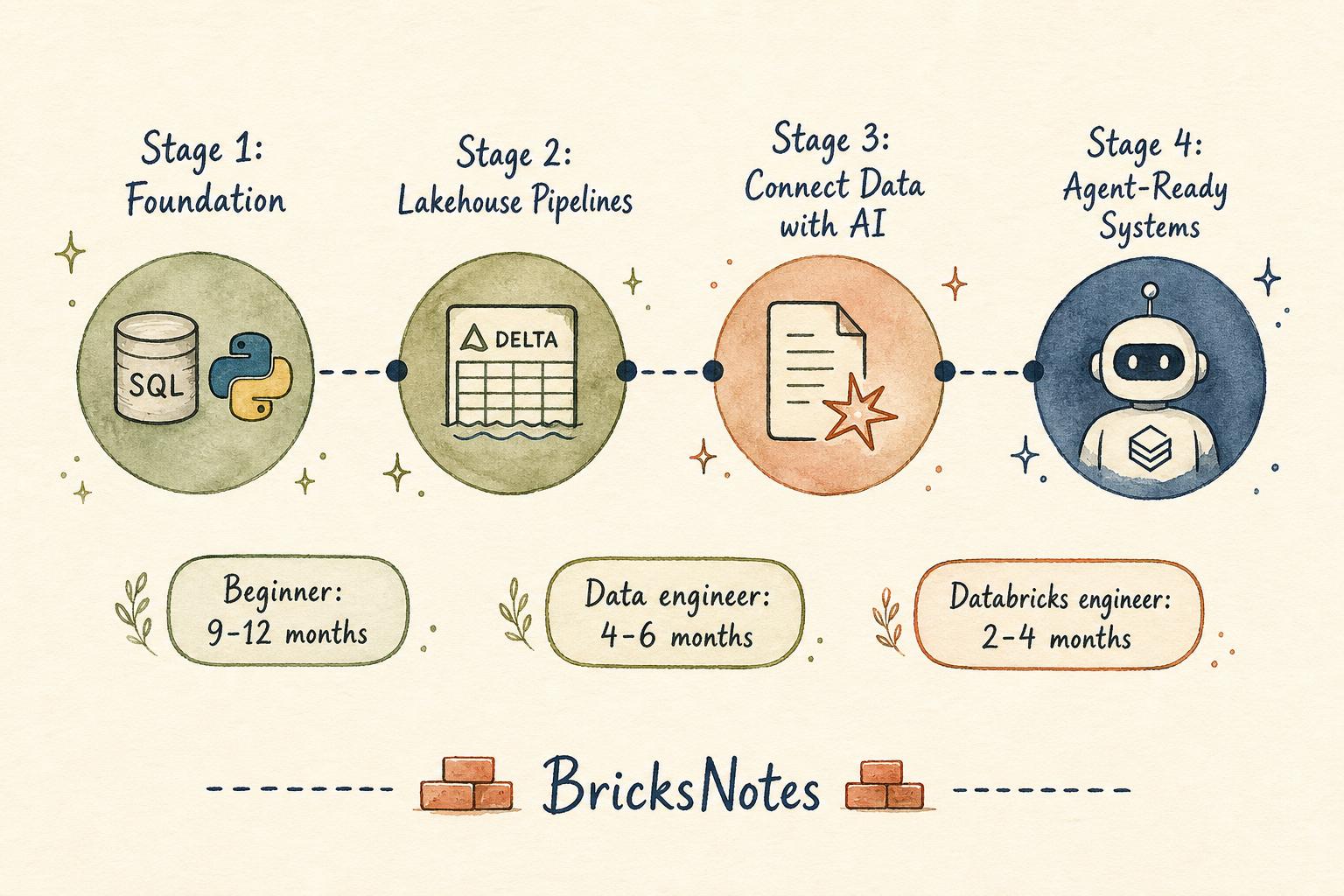
Skip the strict 12-month plan. Use four stages you can move through at your own speed.
Stage 1: Build the data engineering foundation
Get comfortable with SQL and Python. Learn how tables are modeled, how joins behave, how a simple ETL is structured, and how to test transformations. Understand what makes data trustworthy: schema, freshness, uniqueness, and referential integrity. This stage rewards patience.
Stage 2: Build reliable lakehouse pipelines
Move to Databricks and learn to build production-shaped pipelines. Spark DataFrames and PySpark. Delta Lake with schema enforcement, MERGE, and time travel. Unity Catalog for governance. Lakeflow Jobs for orchestration. Monitoring, retries, and cost awareness. By the end of this stage you can ship a bronze, silver, gold pipeline that runs every day without babysitting. The BricksNotes lessons are built for this stage.
Stage 3: Connect data with AI
Now the fun part. Learn to extract structured fields from unstructured documents. Understand embeddings and vector search. Use Model Serving to expose a model as an API. Track experiments with MLflow. Learn how to evaluate an AI output, not just watch it. Build one small AI feature end to end on top of governed Delta tables.
Stage 4: Build agent-ready data systems
The hardest and most valuable stage. Make your data safe for an agent to act on. That means clear business definitions, semantic layers, Unity Catalog permissions, tool interfaces with narrow scopes, memory and observability, cost controls, and a human review path for anything sensitive. This is where The Context Advantage frame becomes useful.
An approximate timeline
- Beginner: 4 to 6 months.
- Existing data engineer: 2 to 3 months.
- Experienced Databricks engineer: 1 to 2 months.
What these timelines assume
These ranges are not promises. They assume a few specific things. Adjust up or down based on your own situation.
- Project scope. You are building the three portfolio projects in this guide, not a full production platform. One retail lakehouse pipeline, one AI document pipeline, and one governed data agent, at learning size.
- Time commitment. Around 8 to 10 focused hours per week. Fewer hours means longer timelines, not a weaker outcome. More hours mostly buys depth, not speed.
- Starting skills. Beginner means comfortable with basic programming and willing to learn SQL from scratch. Existing data engineer means fluent SQL and Python and shipping pipelines already, just new to Databricks and AI. Experienced Databricks engineer means daily Delta Lake, Unity Catalog, and Jobs work already in production.
If your reality is different, trust the stages more than the months. The order matters. The pace is yours.
Certifications validate progress. They do not replace projects, debugging experience, or production thinking.
Which Databricks certifications matter
Pick the ones that match your stage. Do not collect all of them.
- Databricks Certified Data Engineer Associate. The base credential. It proves you can build pipelines on Databricks. Every AI data engineer should hold this. Practice it for free with the Associate practice exam.
- Databricks Certified Generative AI Engineer Associate. The most directly relevant next step for this roadmap. It covers LLM solutions, RAG, Model Serving, MLflow, Unity Catalog governance, evaluation, and monitoring. If you want one AI credential, this is it.
- Databricks Certified Data Engineer Professional. Take this later, after real production experience. It tests depth on streaming, performance, and reliability. Try the free Professional practice exam when you feel ready.
- Databricks Certified Data Analyst Associate. An optional branch for people drawn to Databricks SQL, dashboards, and AI/BI Genie. Useful if you sit closer to analytics teams.
The full comparison lives on the certification guide.
Three portfolio projects employers can understand
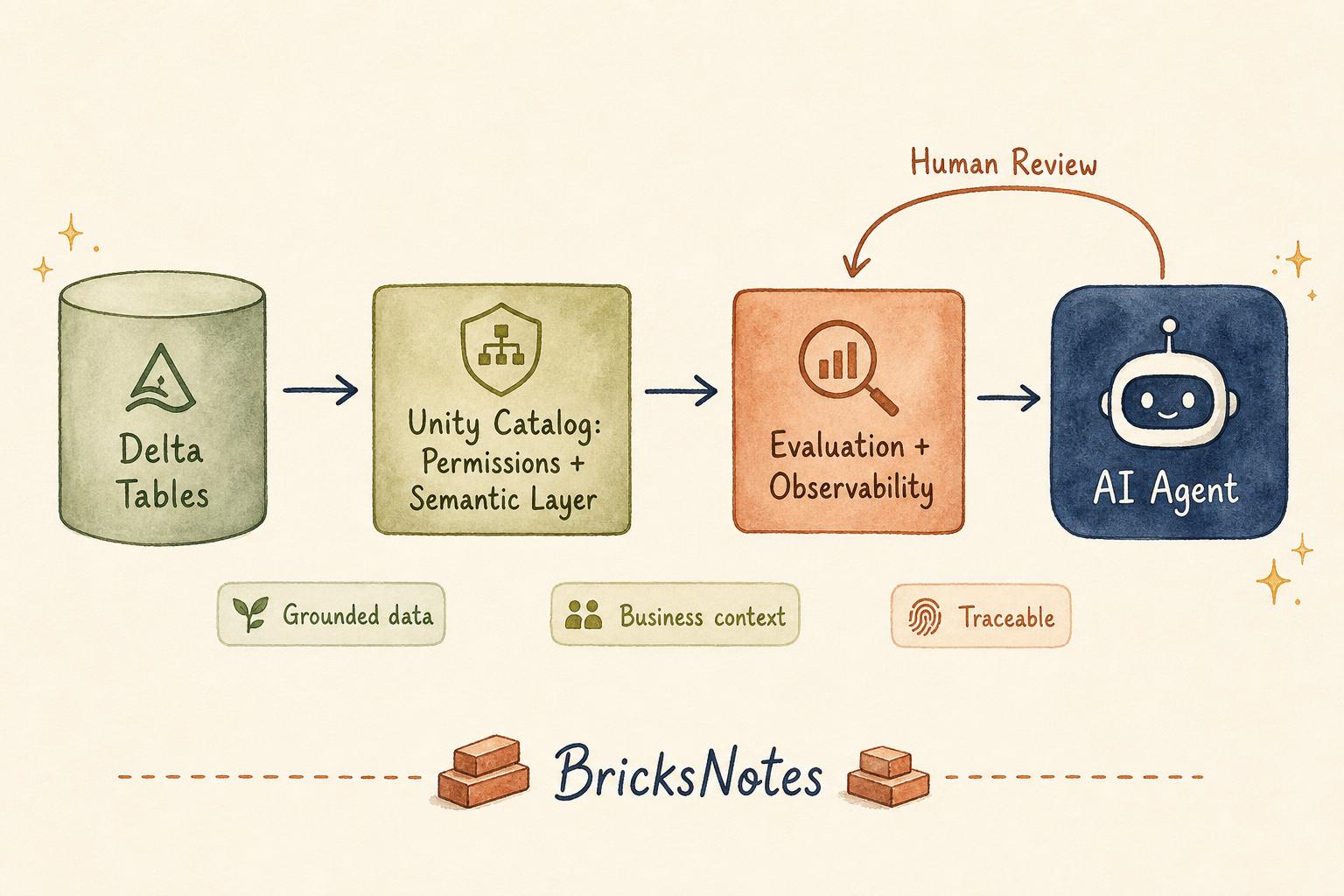
Employers do not read course lists. They read projects. Build these three, in order.
Project 1: Retail Lakehouse Pipeline
Pick a public retail dataset. Ingest orders, customers, products, and returns. Build bronze, silver, and gold layers in Delta. Add schema enforcement, duplicate handling, data quality checks, incremental processing, and monitoring. Write a short README that explains the choices you made. This is your proof that you can build a reliable pipeline.
Project 2: AI Document Processing Pipeline
Pick a document type. Invoices, resumes, support tickets, or policy PDFs all work. Build a pipeline that extracts structured fields from the documents, keeps a reference back to the source, validates the outputs, and writes the governed results into a Delta table. Track the extraction runs with MLflow. This is your proof that you can safely put AI inside a pipeline.
Project 3: Governed Data Agent
Take the gold tables from Project 1. Let an agent, or a Genie space, answer business questions on top of them. Add Unity Catalog permissions, a small semantic layer with business definitions, an evaluation set of real questions, traceable answers, cost monitoring, and a human review path for anything that writes back. This is your proof that you can build a system an agent can safely use.
Three projects. Data moving reliably. AI reading data safely. Agents acting on data with human oversight. That is a portfolio.
What you do not need to learn first
There is a long list of tools the internet says you need. Ignore most of it at the start.
You do not need to:
- Train foundation models
- Master advanced deep learning math
- Learn every vector database on the market
- Learn every orchestration framework
- Build complex multi-agent systems
- Collect ten different cloud certifications
Start smaller. Start by making one dataset reliable. Make its meaning clear. Secure it. Test it. Observe it. Then connect it to AI.
That one sentence is the whole job.
Common mistakes
A few patterns quietly slow people down.
Chasing models before data. New models arrive every month. Your data has not changed. Fix the data first.
Skipping data contracts. Agents fail loudly when a column changes without warning. Write down what each column means and who owns it, even in a short markdown file.
Treating agents as black boxes. If you cannot trace why an agent said what it said, you cannot fix it. Build traceability from day one.
Collecting frameworks instead of shipping one project. One finished project teaches more than ten tutorials. Pick your Project 1 today.
How context engineering changes data engineering
The word that keeps coming up in serious AI work is context. Not model. Not prompt. Context.
A helpful frame is the four Cs from The Context Advantage:
- Context. What the agent knows before it answers. This is where data engineering lives now.
- Control. What the agent is allowed to do, and how you know.
- Cost. What the whole system truly costs to run, not just the tokens.
- Choice. How free you stay as models, vendors, and platforms shift.
Read the four Cs alongside your Databricks work. They are the thinking layer that keeps AI systems honest at organizational scale. The BricksNotes Context Advantage hub collects the essays worth reading.
Your first 30 days
Enough theory. Here is a gentle 30 day start.
- Week 1. Set up Databricks Free Edition. Work through Start Here and the DataFrames lesson. Write your first notebook.
- Week 2. Work through the Delta Lake, Medallion Architecture, and Data Quality lessons. Start Project 1.
- Week 3. Work through Unity Catalog and Workflows. Finish Project 1 and take the free Associate practice exam.
- Week 4. Read Your AI is Ready. Is Your Data Foundation? and Context, Control, Cost, Choice. Sketch Project 2 on paper.
You will not be an AI data engineer in 30 days. You will be someone who has started, seriously, on the right foundation.
Two resources for the complete journey
BricksNotes provides the hands-on foundation. SQL, PySpark, Delta Lake, Unity Catalog, medallion architecture, practical lessons, and free certification practice exams. Everything you need to move confidently through Stages 1, 2, and most of Stage 3.
The Context Advantage provides the thinking layer for the agentic era. How Context, Control, Cost, and Choice determine whether AI systems work reliably inside real organizations. It is the reading that keeps Stage 4 grounded.
Use them together. Build the foundation on one. Think about the four Cs on the other.
Start learning with BricksNotes
The AI data engineer is the engineer who makes organizational data reliable, understandable, governed, and usable by both people and AI agents.
You do not need to master every tool. You need to make one dataset trustworthy, then another, then a pipeline, then a small AI feature on top. Stage by stage. Project by project.
Start today with the free Databricks lessons. We will meet you inside.